
Misciano Textile Materials Index 2026
The reference study on the performance and impact of fashion fabrics
The authoritative textile materials guide
Discover the most comprehensive study on textile materials used in contemporary fashion. Our 2026 Index analyzes 20 materials across 10 performance, sustainability, and value criteria.
This study is an editorial estimate by the Misciano editorial team, based on public technical documentation (standards, material datasheets, literature), without laboratory tests commissioned by Misciano. It assesses technical performance, everyday comfort, long-term durability, and environmental impact.
Our goal is to provide fashion professionals, informed consumers, and textile industry stakeholders with a reliable and transparent database for making informed choices. This index combines public technical documentation and a comparison of published references to create a complete and objective overview of the 2026 textile materials landscape.
Our Editorial Methodology
Each material is assessed by the Misciano editorial team, as an editorial estimate based on public technical documentation, without laboratory tests commissioned by Misciano.
Our methodology is based on four complementary pillars that structure the editorial estimate. Each pillar refers to public standards and documentation, and the scores are not measurements made by Misciano.
The public references are reviewed by the Misciano editorial team, which combines textile knowledge and fashion practice to structure these estimates for industry stakeholders.
Comfort & Performance
Editorial estimate based on public references: breathability referenced to the ISO 11092 standard, with softness, drape and thermoregulation rated from public material documentation.
Durability & Longevity
Editorial estimate based on public references: abrasion referenced to the Martindale method (ISO 12947), pilling to ISO 12945 and colour fastness to ISO 105, with durability rated from public material documentation.
Environmental Impact
Editorial estimate based on public references: carbon footprint approach referenced to the GHG Protocol, chemical considerations referenced to REACH, and recyclability and biodegradability rated from public material documentation.
Value Ratio
Editorial estimate based on public market information and material documentation: cost per meter, European market accessibility and supply availability, compared with perceived value.
Rankings by Criteria
Discover the best materials for each performance category. Our rankings are based on our editorial estimate, drawn from public technical documentation, not on laboratory tests.
| # | Score | Material | Characteristics |
|---|---|---|---|
| 1 | 95/100 | Cachemire | Douceur exceptionnelle, isolation thermique |
| 2 | 92/100 | Soie | Légèreté, thermorégulation naturelle |
| 3 | 88/100 | Coton bio | Respirabilité, hypoallergénique |
| # | Score | Material | Characteristics |
|---|---|---|---|
| 1 | 96/100 | Nylon recyclé | Résistance à l'abrasion, longévité |
| 2 | 93/100 | Polyester recyclé | Tenue des couleurs, robustesse |
| 3 | 89/100 | Lin | Solidité naturelle, amélioration au lavage |
| # | Score | Material | Characteristics |
|---|---|---|---|
| 1 | 98/100 | Chanvre | Faible empreinte carbone, culture sans pesticides |
| 2 | 94/100 | Lin européen | Circuit court, minimal impact hydrique |
| 3 | 91/100 | Tencel | Fibre botanique, solvant recyclé en boucle fermée |
Data Visualizations
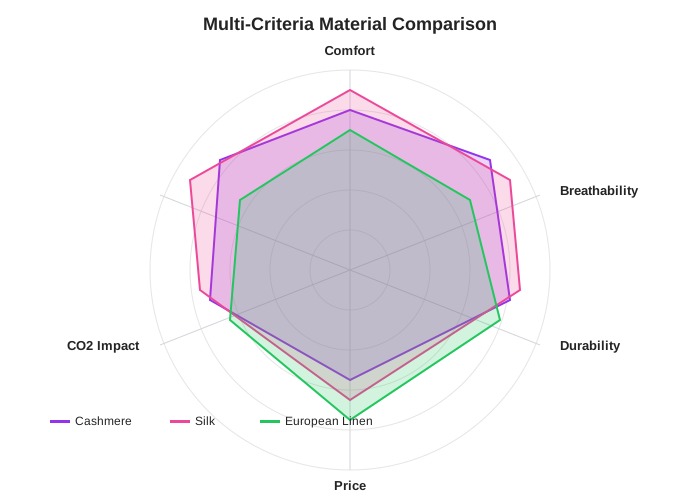
Our interactive charts allow you to visually compare the performance of different materials across multiple dimensions.
Performance Profile
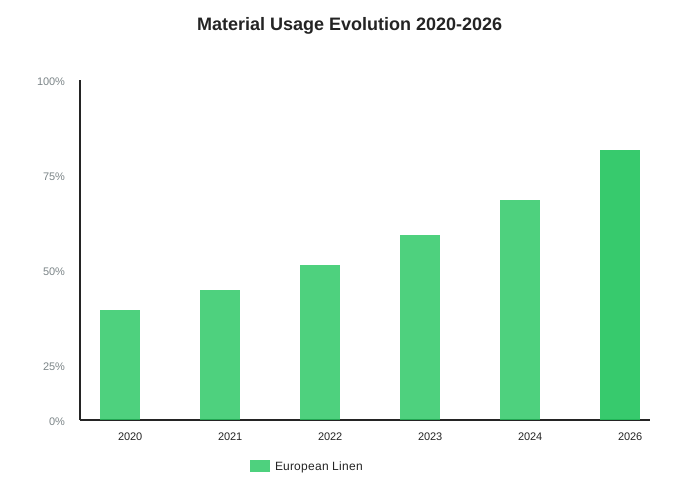
Usage Evolution
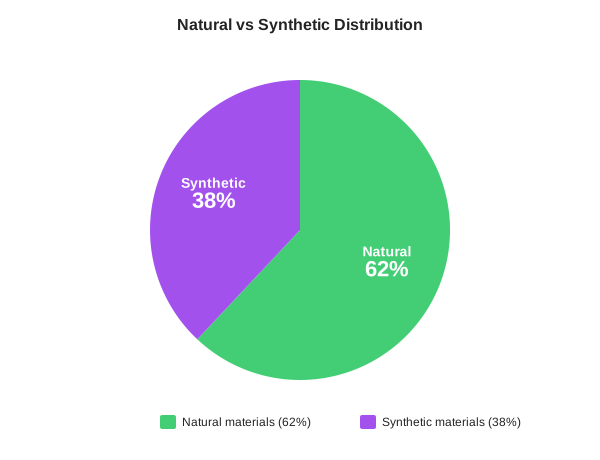
Natural vs Synthetic Distribution
Complete Comparative Table
This comprehensive table presents a detailed comparison of 20 textile materials across 8 essential performance criteria. Ratings are our editorial estimate.
| Material | Comfort | Breathability | Care | Durability | Price | CO2 Impact | Recyclability | Origin |
|---|---|---|---|---|---|---|---|---|
| Cachemire | ★★★★★ | ★★★★☆ | ★★★☆☆ | ★★★★☆ | ★★☆☆☆ | ★★★☆☆ | ★★☆☆☆ | Mongolie, Chine |
| Soie | ★★★★★ | ★★★★★ | ★★★☆☆ | ★★★★☆ | ★★★☆☆ | ★★★☆☆ | ★★☆☆☆ | Chine, Italie |
| Lin européen | ★★★★☆ | ★★★★★ | ★★★★★ | ★★★★★ | ★★★★☆ | ★★★★★ | ★★★★★ | France, Belgique |
Cachemire
Soie
Score legend
- ★★★★★ Excellent
- ★★★★☆ Good
- ★★★☆☆ Average
- ★★☆☆☆ Poor
Materials Trends 2026
The 4 major trends transforming the textile materials landscape in contemporary fashion.
Rise of European Linen
Linen cultivated in Europe is experiencing exceptional growth, driven by local cultivation and low environmental impact.
Decline of Virgin Polyester
Petroleum-based polyester is losing market share to recycled and bio-based alternatives.
Explosion of Recycled Fibers
Recycled materials are experiencing massive adoption, driven by regulations and consumer demand.
Return of Hemp
Hemp is becoming a prized material again thanks to its technical properties and exceptional carbon footprint.
How to Use This Index
This index was designed to help different audiences in their decisions regarding textile materials. Here is how to get the most out of it according to your profile.
Consumers and Buyers
Consult the rankings by criterion to identify materials that match your priorities. If you are looking for comfort, refer to the Top 10 Comfort. For a sustainable purchase, prioritize materials well ranked in Durability and Environmental Impact. The comparative table allows you to directly compare several materials on all criteria simultaneously.
Fashion Professionals
Use the detailed data to guide your sourcing and collection choices. The Value Ratio scores help you optimize your costs while maintaining quality. The 2026 Trends section enlightens you on market evolution and emerging materials to integrate in your future collections. Charts are downloadable for your presentations.
Researchers and Students
The methodology section lists the public reference standards behind our editorial estimates, so you can check and build on them. Cite the study according to the academic formats provided in the Citation section. The complete PDF contains the editorial estimates and bibliographic references for your research work. Do not hesitate to contact us for methodological questions.
Brands and Communicators
Share the study with your audience to demonstrate your commitment to transparency and quality. Email, LinkedIn and Twitter share buttons facilitate distribution. You can cite the scores of your used materials to highlight your textile choices. Creative Commons BY-NC license allows sharing provided you mention the Misciano source.
Study Transparency and Limitations
In the interest of scientific transparency and credibility, we wish to specify the conditions under which this study was carried out as well as its methodological limitations.
Sources and Sampling
No textile samples were tested or sourced by Misciano for this index. The scores are an editorial estimate by the Misciano editorial team, based on public technical documentation (standards, material datasheets, literature).
Team and Expertise
This index is written by the Misciano editorial team. It has no research and development department, no laboratory partner and no peer review committee.
Funding and Independence
This study was entirely funded by Misciano Paris without any external contribution from brands, suppliers or sector organizations. The conclusions are independent of any commercial influence. The editorial estimates are produced by the Misciano editorial team alone.
Methodological Limitations
The scores presented are an editorial estimate and may vary according to suppliers, manufacturing processes and actual usage conditions. Durability ratings are not based on laboratory tests and may differ from natural wear over several years. Environmental impact ratings draw on average sector data and can vary significantly depending on specific supply chains.
Updates and Versioning
This index will be updated annually to incorporate technological developments, new emerging materials and user feedback. This 2026 version constitutes the first reference edition. Previous versions will be archived and accessible for historical comparison. Last update of this page: February 25, 2026.
Download the Complete Index
Get the complete study in PDF with the detailed editorial estimates, charts and in-depth analysis.
This complete PDF version of the Misciano Index 2026 compiles the editorial estimates and recommendations presented on this page, enriched with exclusive content and high-resolution graphics. Ideal document for archiving, professional presentation or offline consultation. Free and freely downloadable without registration.
- 24 pages of detailed analysis
- 20 materials compared
- Complete charts and tables
- Editorial methodology
- 2026 trends
PDF 24 pages - 2.8 MB
How to cite this study
This study is provided freely with the aim of transparency and knowledge sharing. You are encouraged to cite it in your academic work, professional articles or presentations.
We provide below three standard citation formats recognized by academic institutions and scientific publications. Choose the appropriate format according to your needs and click the button to copy the complete reference.
APA Style
MLA Style
Chicago Style
Share this study
Questions about the study
For any methodological questions, requests for additional data or collaboration on textile research projects, our team is at your disposal.
Contact our team2026 Misciano Paris. All rights reserved.
This study is published under Creative Commons BY-NC 4.0 license. You are free to share and adapt the content provided you mention the source and do not use it commercially.
Method and sources
The ratings, scores and rankings on this page are an editorial estimate by the Misciano editorial team. They are based on public technical documentation (standards, material data sheets, specialist literature). They do not come from laboratory tests carried out by or for Misciano.
Standardised test methods these criteria refer to (public standards, available on iso.org):
- ISO 12947-2:2016 : abrasion resistance (Martindale method)
- ISO 12945-2:2020 : pilling (modified Martindale method)
- ISO 105-C06:2010 : colour fastness to washing
- ISO 105-B02:2014 : colour fastness to light
- ISO 13934-1:2013 : tensile properties of fabrics
- ISO 11092:2026 : thermal and water-vapour resistance (thermal comfort)
- ISO 9237:1995 : air permeability (breathability)
- ISO 3801:1977 : mass per unit area of woven fabrics
- ISO 1833-1:2020 : quantitative analysis of fibre blends
- ISO 2076:2021 : generic names of man-made fibres