Women wrist size: which watch size to actually choose
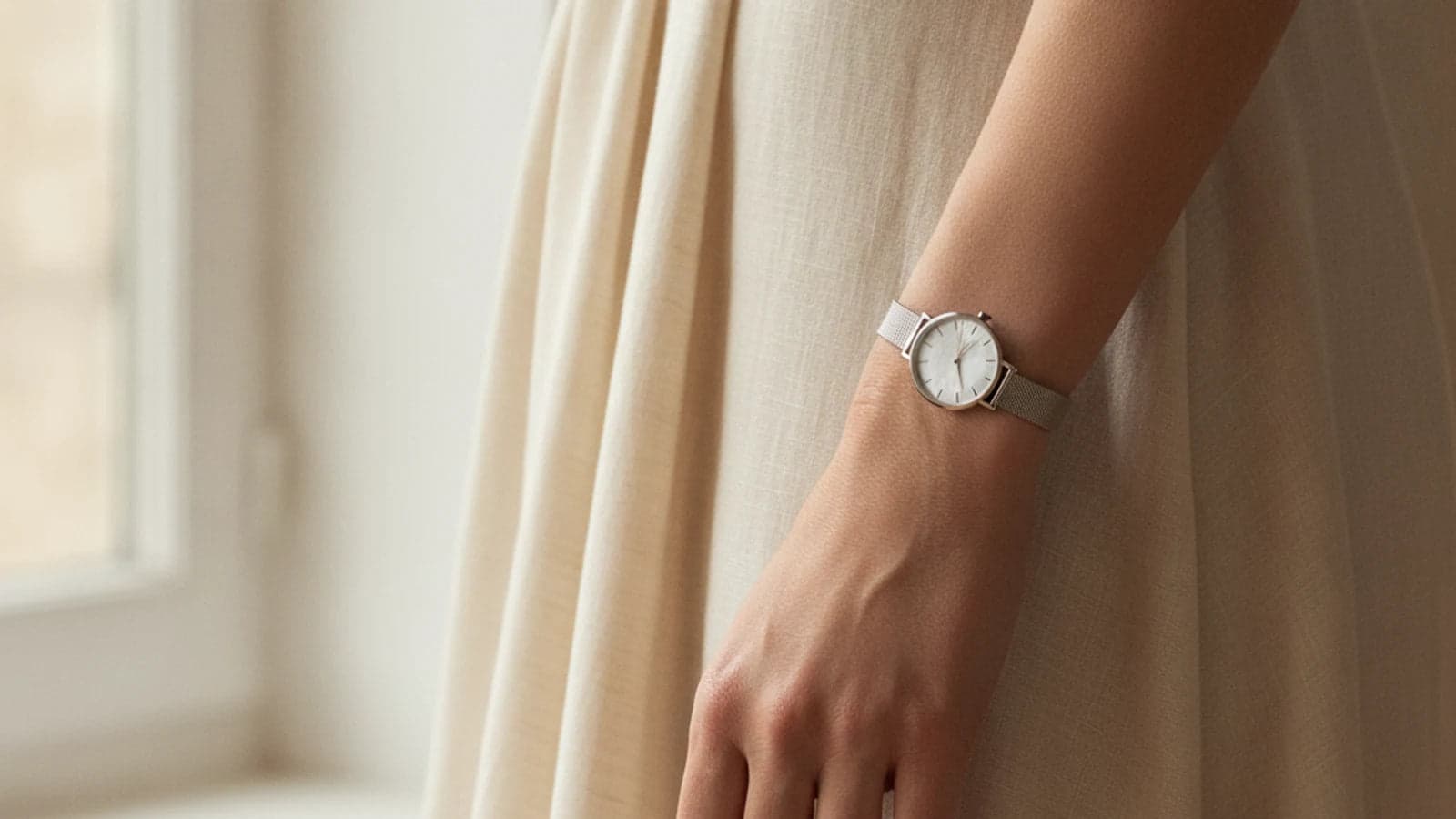
A slim wrist changes everything. The same watch that looks right on a 17 cm wrist feels like a costume at 14.5 cm, and this discrepancy has nothing to do with taste: it is geometric. Yet three measurements are enough to avoid mistakes, and none of them appear on standard product sheets.
Women's wrist size: real numbers, not marketing averages
The average adult female wrist circumference falls mostly between 14 and 18 cm, with a median observed around 15.5 to 16 cm. Below 15 cm, we consider the wrist slim. This is precisely where most buying errors occur, because standard offerings are calibrated for 16 to 17 cm.
How to measure correctly, in two minutes
Place a flexible tape measure just past the prominent wrist bone, on the hand side, without tightening. If you don't have a flexible tape, wrap a strip of paper around, mark the meeting point with a pen, and transfer it to a rigid ruler.
Two precautions no one mentions: measure at the end of the day, as the wrist swells slightly over the hours, and measure the wrist of your non-dominant hand, which is usually a bit slimmer and is also the wrist where the watch experiences the least wear.
The three thresholds that decide everything
- Under 15 cm: case size 28 to 32 mm. Beyond that, the lugs overhang the flat of the wrist.
- 15 to 17 cm: case size 32 to 36 mm. The most comfortable zone, and the best supplied.
- Over 17 cm: case size 36 to 40 mm, with no fear of it being too large.
On a slim wrist, it is never the diameter that betrays a poorly chosen watch, it is the lug-to-lug distance. A well-designed 34 mm piece wears better than a 30 mm one with straight, long lugs.
 Camille Laurent Fashion and accessories editor, Misciano Paris
Diameter is not enough: measure the lug-to-lug distance
This is the most common mistake. Two watches advertised as 34 mm can wear very differently, because the decisive measurement is not the dial diameter but the lug-to-lug distance, from one strap attachment to the other.
The rule is simple: this distance should not exceed the width of the flat part of your wrist. On a 15 cm wrist, this flat area measures approximately 40 to 45 mm. A watch with a lug-to-lug of 46 mm will visibly overhang, even if its dial is only 33 mm.
Curved or straight lugs: a 3 mm difference
Lugs that curve downward hug the wrist and gain 2 to 3 mm of tolerance compared to straight lugs. On a slender wrist, this curvature matters more than the stated diameter.
Thickness plays the same role: beyond 10 mm, a case catches on sleeves and rolls over the bone. Under 8 mm, it slides under a shirt cuff without effort. This is why a watch with a slim strap and a flat profile remains the safest choice on a slender wrist, regardless of the outfit.
Strap width: the proportion we forget
The strap should measure about half the case diameter. On a 32 mm case, aim for a 14 to 16 mm strap width at the attachment. Too wide, it overwhelms the wrist; too narrow, it looks fragile and unbalanced.
| Wrist circumference | Recommended case | Max lug-to-lug | Strap width |
|---|---|---|---|
| 14 to 15 cm | 28 to 32 mm | 40 mm | 12 to 14 mm |
| 15 to 16 cm | 32 to 34 mm | 44 mm | 14 to 16 mm |
| 16 to 17 cm | 34 to 36 mm | 47 mm | 16 to 18 mm |
| 17 cm and above | 36 to 40 mm | 50 mm | 18 to 20 mm |
Links, buckle and real adjustment
A steel bracelet is shortened by removing links, but not all models can be adjusted small enough. Check the number of removable links before purchase: on a 14.5 cm wrist, three links often need to be taken out. A Milanese bracelet, however, offers continuous adjustment, making it the safest option when you are unsure.
A control check: the watch should be able to pivot slightly but never slide over the wrist bone. If it falls onto your hand when you lower your arm, there are still one or two links too many.
Matching the watch to the neckline and sleeve
A watch is always read in relation to its surroundings. Under a fluid long sleeve, the case appears intermittently: a slim, discreet model works better than a substantial piece that catches on the fabric. With a sleeveless dress, the wrist is fully visible and can accommodate a slightly wider case or a detailed bracelet.
Bracelet metal and garment material
The logic is one of controlled contrast. A steel or Milanese bracelet responds well to satin and crepe, whose surfaces reflect light. A supple leather bracelet suits linen and cotton, which are more matte. On a highly ornate piece, such as an embroidered or sequined dress, the watch is best kept understated: a slim case, a plain bracelet, no stones.
The same reasoning applies to other accessories. If you are already wearing a silk scarf tied at the wrist or on your bag, keep the watch strictly neutral to avoid visual overload.
Measure before you compare
Your wrist circumference in centimeters is the only data that allows you to filter models. Without it, product specifications are meaningless.
Check the lug-to-lug distance
The lug-to-lug distance determines the fit far more than the stated diameter. It must remain within the width of the flat part of your wrist.
Seek slimness
Under 8 mm thick, a watch goes anywhere: under a shirt sleeve or on a bare wrist.
Maintain neutrality
With an already detailed outfit, the watch should fade into the background. A plain bracelet, a sober dial, no rhinestones.
Case shape: round, rectangular, or oval on a slim wrist
At the same diameter, the shape strongly alters perception. A round case occupies the maximum surface area for a given width: it is the most visible. A vertical rectangle, conversely, elongates the wrist and appears more discreet, as its width remains less than its height.
The useful width benchmark
On a slim wrist, what matters is not the dial's surface area but its transverse width, meaning the dimension perpendicular to the arm. A 26 mm wide rectangle will appear lighter than a 32 mm round, even though their display areas are comparable.
Oval and tonneau cases offer a compromise: their curve follows the line of the wrist and avoids the rigid plate effect that a square with sharp angles can sometimes produce.
Color and size effect
A light dial visually enlarges the case, a dark dial reduces it. On a slender wrist, a black or anthracite dial in a 34 mm case will give the impression of a 32 mm. This is a free lever, often overlooked, to broaden your choice of models without exceeding the limits.
Adapting the watch to the time of day
The same person does not need the same watch at the office and in the evening. The constraint is not aesthetic, it is functional.
Daytime and the office
The wrist is in constant motion, often in contact with a keyboard or work surface. The watch must be slim to avoid catching, and its bracelet sufficiently adjusted so it does not pivot. A Milanese or supple leather strap fulfills this role better than a heavy link bracelet.
Evening and formal occasions
The wrist is more often visible, still, and photographed. This is the moment when a slightly wider case or a detailed bracelet makes sense. The lug-to-lug rule remains valid: you gain in presence, never in overhang.
This contextual reasoning aligns with the approach we apply to the entire wardrobe, particularly in our guide on relaxed elegance, where proportion always takes precedence over the piece itself.
The costliest mistakes
- Buying from a packshot photo: studio visuals are shot on calibrated mannequin wrists, never a real wrist. Trust the millimeters, not the rendering.
- Confusing discreet with small: a 30 mm watch that is too thick will be more noticeable than a perfectly flat 34 mm one.
- Forgetting weight: a heavy steel case on a thin strap will tilt and rotate around the wrist. Balance matters as much as size.
- Neglecting legibility: reducing the diameter also reduces the dial. Below 28 mm, indices become difficult to read on a daily basis.
To explore further the harmony between body shape and clothing, our guide on choosing fabrics according to body shape applies the same logic of proportions to the entire silhouette.
A watch that lasts: what to look for
Fineness should not come at the cost of fragility. Three points deserve verification before purchase, regardless of budget.
The crystal
A treated mineral crystal resists daily micro-scratches adequately. Sapphire remains superior but slightly thickens the profile. For a watch intended for dressy wear, mineral is perfectly sufficient.
Water resistance
Three ATM covers splashes and rain, not showering or swimming. For a watch worn in the evening and at the office, this is ample and avoids paying for unnecessary reinforced gaskets.
Strap replacement
Check that the lug width matches a common standard (12, 14, 16 or 18 mm) and that the spring bars are quick-release. A proprietary strap condemns the watch the day the leather wears out, while a standard one can be replaced in two minutes.
Three real-life scenarios, from wrist to outfit
The thresholds make sense when applied. Here are three common configurations and how to interpret them.
14.5 cm wrist, fluid sleeveless dress
The wrist is bare and fully visible: any proportion mismatch is obvious. Aim for a case of 30 mm maximum, lug-to-lug under 40 mm, thickness under 8 mm. A 14 mm Milanese strap avoids the issue of too few links. A dark dial to further refine the perception.
16 cm wrist, long-sleeved shirt
The constraint becomes thickness, not diameter. Under a shirt cuff, a 34 mm case with 7 mm thickness passes without forcing, whereas a 32 mm one that is 11 mm thick will catch the fabric with every movement. Here, thinness takes precedence over size.
17.5 cm wrist, structured evening wear
The margin is comfortable. A 36 to 38 mm case remains proportionate and supports a wider strap, up to 18 mm. This is the only configuration where a model with visible links naturally finds its place without weighing down the silhouette.
Caring for a fine watch to make it last
A fine watch is more exposed than a thick model: less material, tighter components, a crystal often closer to the dial. A few gestures truly change its lifespan.
Strap cleaning
On a Milanese, the mesh retains dust and cream residue. A rinse with lukewarm water followed by complete drying, once a month, is enough to prevent tarnishing. On leather, the enemy is moisture: avoid prolonged contact with damp skin in summer, which stiffens and cracks the material.
Storage
Laid flat, never stacked under other objects. A thin case is more prone to distortion than a thick one under lateral pressure. If storing several pieces together, an individual fabric pouch prevents cross-scratches.
Servicing
On a quartz movement, battery replacement is an opportunity to have the gasket checked. A dry gasket lets moisture in, and this is the primary cause of failure in dress watches that are worn infrequently.
Article by Camille Laurent
Published on 19/03/2026 at 15:30
About the Author
Camille Laurent explores materials from the inside: their properties, care, and behavior over time. She translates technical expertise into concrete, accessible advice.
→ Learn more about Camille