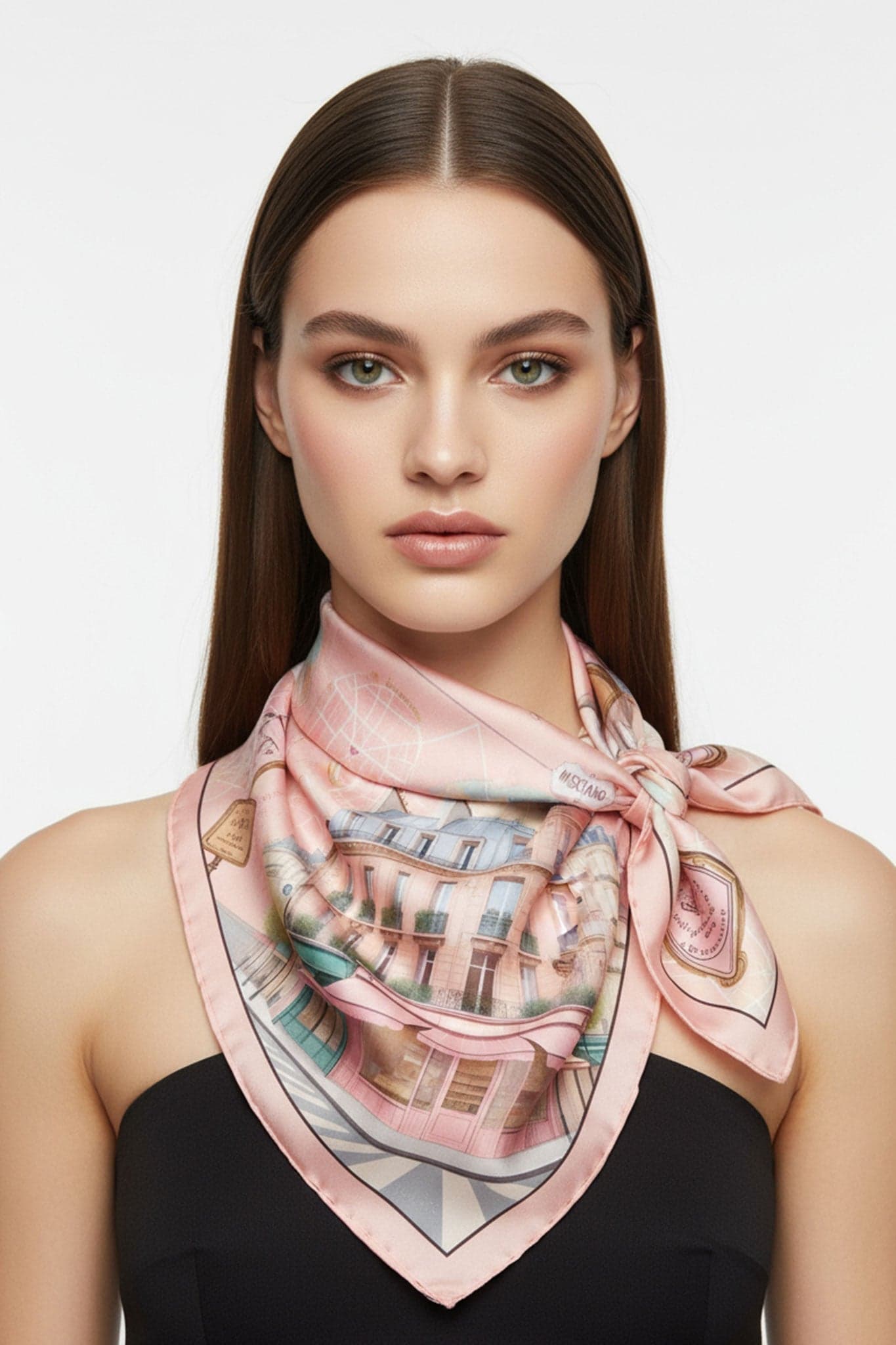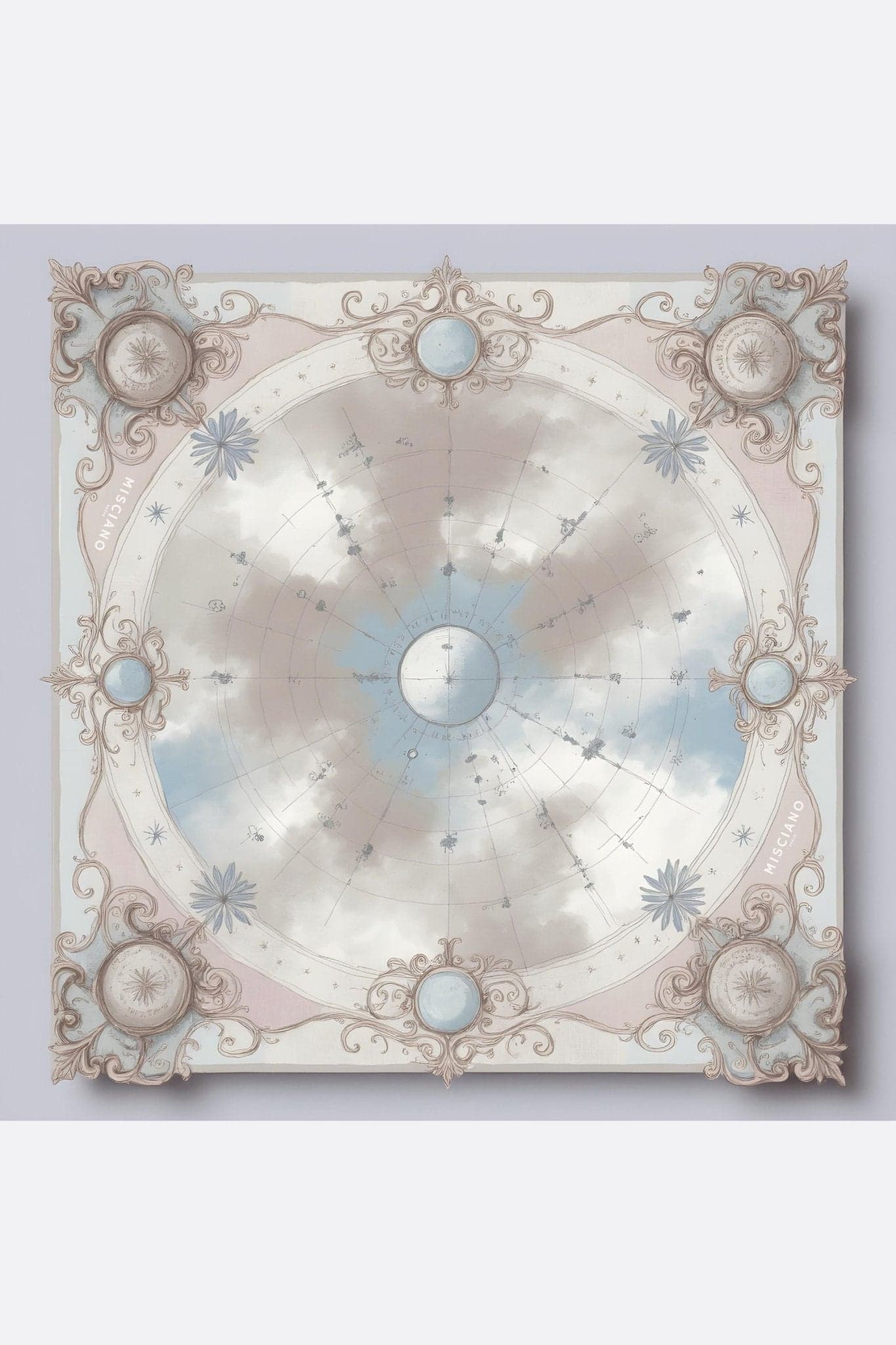
History of the silk square: origins, codes, and know-how

You have a square in your hands and, beyond the pattern, a question arises: where does this textile language that seems immediately “held”, precise, almost ceremonial, come from?
The history of the silk square is not a series of anecdotes: it is a useful framework for recognizing a beautiful drape, understanding why some prints seem deeper, and identifying the details (hand, rolled edge, density) that make the difference when buying, gifting, or passing on. Here, we trace the chain: from the silk roads to the French square, from graphic codes to workshop gestures, with concrete markers to apply at your next fitting.
From the silk roads to the first squares: when the material imposes its discipline
The history of the silk square begins less with a shape than with a material. Silk, as soon as it circulates between Asia and the West, imposes a discipline: it captures light at the slightest movement, reveals the tensions of the weave, and forgives neither a poorly fixed dye nor an irregular fiber.
On caravan and then maritime routes, silk is first a status signal - but above all a field of technical experimentation. The fabrics arrive in pieces, are cut, and transformed. The idea of the “square” gradually emerges from a practical need: to obtain a stable format, easy to fold, tie, store, transport, and especially to repeat in organized production.
Before the square became a codified accessory, similar uses were observed: scarves, veils, precious handkerchiefs, pieces of fabric worn around the neck or on the head. The key point is the border.
As soon as a pattern is framed, a simple textile fragment is transformed into a finished object. The border acts like a frame: it visually “holds” the composition and, technically, it requires a clean finish. It is already a foretaste of what will give the square its authority: the balance between the image (printed or woven) and the finishing line (hem, rolled edge, selvage).
To read these origins in a current square, observe two very concrete things. First, the hand: silk that is too “brittle” or dry often betrays excessive finishing, intended to artificially give it hold. Then the way the light glides: on quality silk, the shine is not a uniform mirror, but a vibration, a relief.
These clues, inherited from centuries of trade and refinement, reconnect you to the original logic: silk must remain alive, yet controllable - a paradox that underpins the entire history of the silk square.
Birth of the square in Europe: the workshop, the measure, and the taste for the “held” design
When Europe structures its textile industries (Lyon leading for silk), the square becomes an economic and aesthetic obviousness. Economic, because a standard format allows for planning: yardage, placement of patterns, material waste, finishing time.
Aesthetic, because the square offers a perfect scene for drawing: angles, symmetries, medallions, friezes. Where a fabric by the meter accepts repetition, the square demands a complete composition. The design must “close” neatly, without escape, and that changes everything: a successful square is read like an image, with a center, a hierarchy, breathing spaces.
To chronologically situate these evolutions, here are some historical milestones:
- Antiquity - Middle Ages: The first silk roads connect Asia to the West, laying the foundations for technical and aesthetic exchange.
- Renaissance: Silk becomes a symbol of prestige and innovation, with experiments in formats and finishes.
- 17th - 18th centuries: The rise of textile production in Lyon structures the creation of the square, combining economy and aesthetics.
- 19th century: Industrialization introduces standardized printing and dyeing techniques, reinforcing the notion of a codified square.
- 20th century: The diversification of techniques (screen printing, digital printing) pushes the limits of traditional silk square design.

This European moment is also when quality reflexes are established. The density of the fabric (often expressed in mommes), the regularity of the weave, the drape, the sharpness of printed contours: everything becomes measurable.
Houses and workshops quickly understand that the value of a square does not rest solely on the pattern, but on its ability to maintain a stable geometry when worn. A square that deforms too quickly, whose angles “fall” poorly, or whose border twists after a few wears, breaks elegance.
At this stage in the history of the silk square, finishing takes on an almost moral status: it signifies the seriousness of the workshop.
A clean hem, a sharp edge, a drape that does not “clatter,” a surface that does not fluff: these are silent promises. For you, it is a very simple observation field in-store or upon receiving a purchase: fold the square in half, then again in half.
The edges must align without forcing, the corners must overlap with natural precision. If you feel resistance, asymmetry, or an edge that “pulls,” it is often a sign of an imperfect cut or tensioning.
Finally, Europe imposes a graphic taste: coats of arms, equestrian, disciplined florals, chains, ribbons, cartouches. This vocabulary is not decorative by chance: it is designed to dialogue with the border and survive folding. A square is rarely worn fully deployed; its design must remain legible in fragments. That is why some compositions appear immediately coherent: they have been designed for the fold, a direct heritage of this “workshop + measurement + held design” birth.
Codes of the square: border, center, scale of the pattern, and art of the fold (what history has established)
The current codes are not social conventions: they are the logical consequence of the history of the silk scarf. The first code is the border. Wide or thin, contrasting or tone-on-tone, it dictates perception. A dark border “anchors” the object and immediately structures the knot.
A light border broadens, softens, gives an impression of breath. Historically, the border is also a technical space: it sometimes hides joints, stabilizes the image, and offers a finishing area where irregularity is immediately visible. This is why workshops respect it as an architectural line.
Second code: the center. In medallion scarves, the center acts as a point of gravity. In “all-over” scarves, repetition must remain controlled to avoid a blurred effect once tied. Again, history speaks: a scarf is made to be folded, and the fold selects.
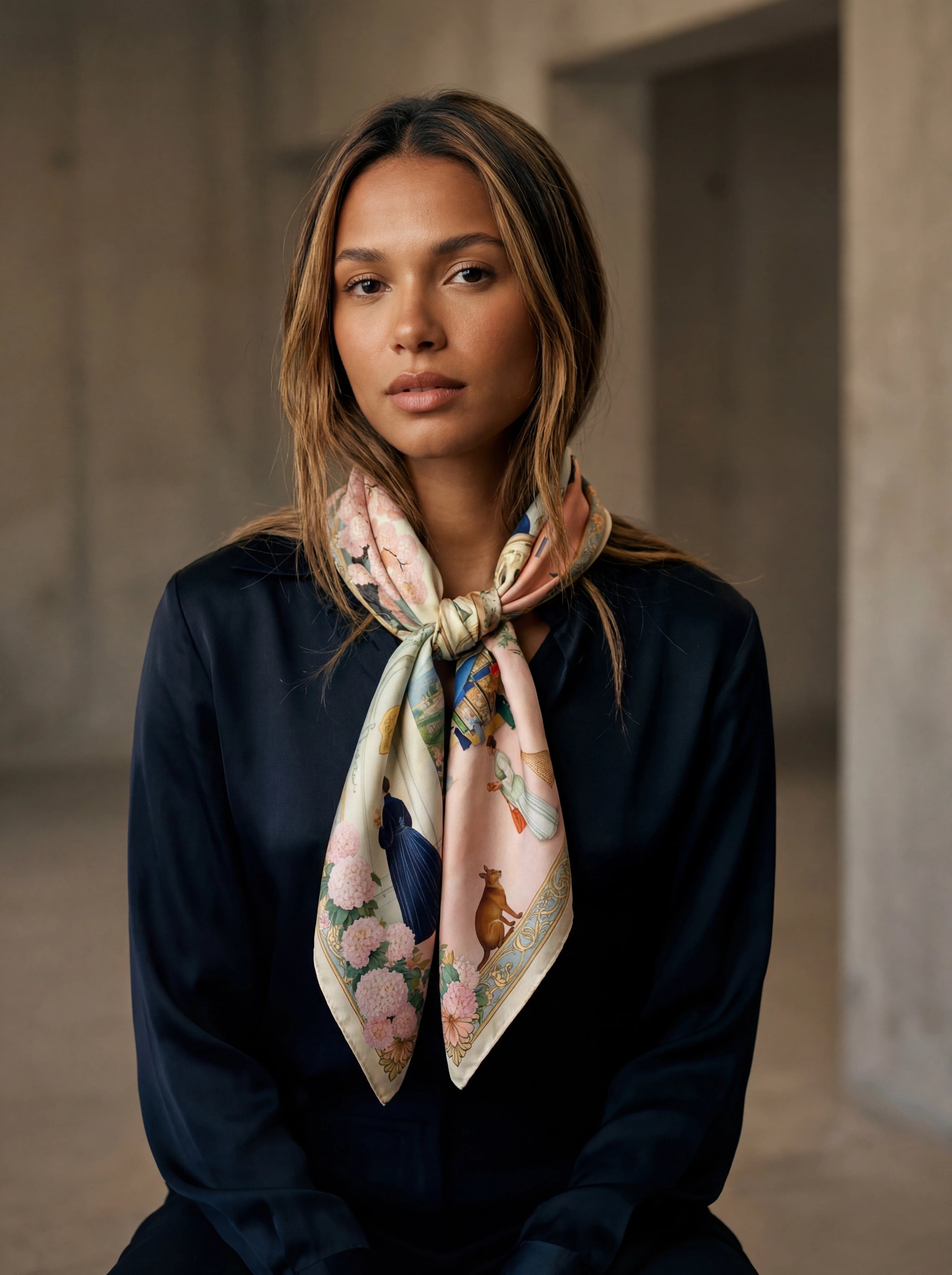
A good design accepts being “cut” without losing its visual hold. Practically, test a scarf by folding it into a triangle then into a band: if, in these two scenarios, you still get a readable rhythm (present border, recurring elements, contrasts), the design is meant to be worn, not just for the flat photo.
Third code: the scale of the pattern. Patterns that are too small can vibrate and tire the eye, especially on very shiny silk; patterns that are too large can disappear in the knot. The historical balance is often found in a scale that allows partial reading: a fragment must remain beautiful. To choose, place the scarf 50 cm from your eyes (mirror distance): if the pattern becomes confused, the scale may be too fine; if you only see a mass, it is too large. This simple gesture reflects centuries of adjustments between design, weaving, and use.
Fourth code: the art of folding. “Classic” folds (triangle, band, accordion fold) are not routines: they are solutions born from constraint. Silk slips, marks, reflects. The domestic fold makes it docile.
This is also where one understands why some scarves appear more “noble”: they accept the constraint without creasing noisily, without creating whitened breaks. Well-dyed and well-woven silk folds with silent suppleness; it does not rustle, it does not whiten at the fold, it maintains color continuity.
If you wish to connect these codes to very specific wearing gestures (according to the size of the scarf, the type of knot, the collar hold), you can complement with our Silk square: expert guide to choose, wear, maintain.
This guide offers details on wearing techniques, maintenance tips, and selection criteria, thus complementing this presentation focused on history, codes, and know-how.
Know-how: from printing to rolled finishing, the gestures that transcend time
The expertise of a scarf is not limited to “printed on silk.” The history of the silk scarf is made of processes, corrections, expert hands, and time. First chapter: the preparation. Even before printing, the silk must be degreased, stabilized, sometimes slightly sized. Too much sizing and the scarf becomes stiff, “paper-like.” Not enough, and it may lack hold at the knot. The desired balance is sensual: a surface that glides under the fingers, but with a fine resistance, like taut skin.
Second chapter: the printing. Depending on the workshops, different techniques are encountered (screen printing, high-end digital printing, sometimes jacquard weaving for structural effects).
Historically, screen printing has long dominated the imagination of the exceptional scarf because it requires a layer-by-layer construction: one color after another, with drying times, alignments, controls.
This logic often gives a particular depth: the flat areas are sharp, the contours have authority, and some shades seem placed “in” the fiber rather than on the surface. With digital, we gain in gradient finesse, photographic complexity, but the demand shifts: perfect mastery of the ink, steam (fixation), the final wash is required, otherwise the colors lose their density and the hand degrades.
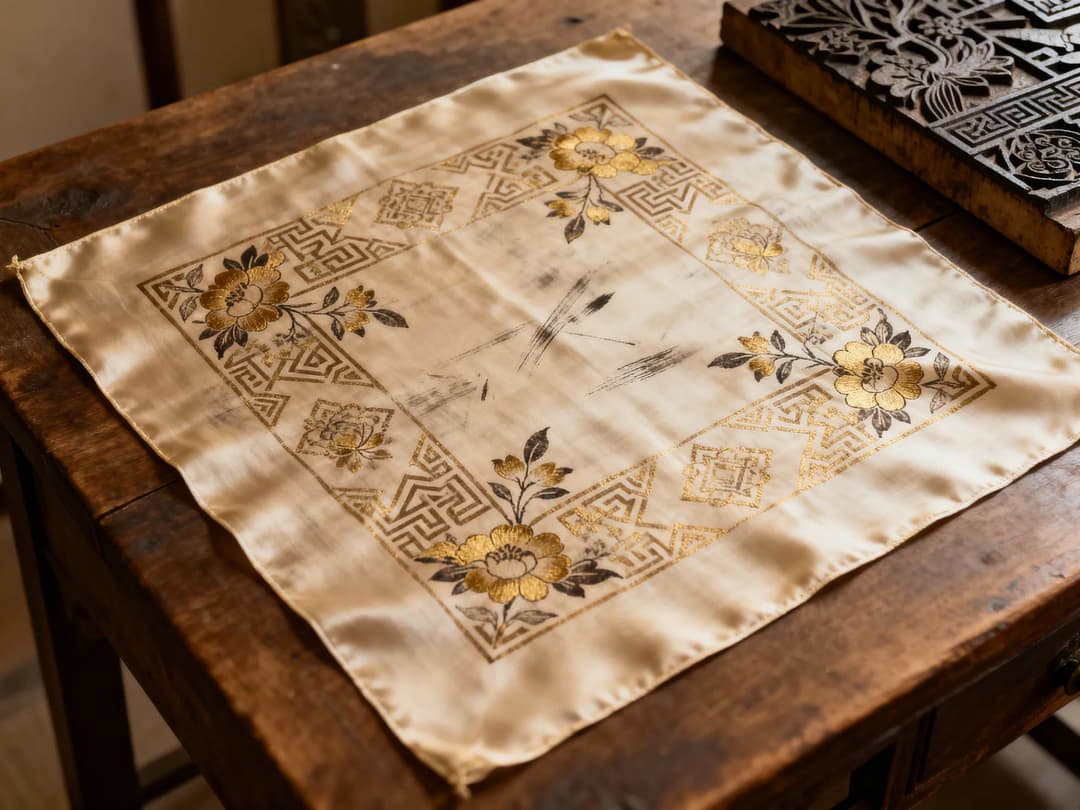
Third chapter: the fixation and washing. This is where the color becomes durable. Insufficient fixation is quickly noticeable: the shade appears beautiful when flat but fades at the fold, or slightly migrates to light areas. In daylight, a well-fixed scarf maintains stable contrast; blacks remain deep, reds do not turn dull brick, blues retain their freshness.
Fourth chapter, the most telling: the finishing, and notably the rolled hem. A hand-rolled hem (or a very carefully finished equivalent) is recognized by a lively regularity: the edge is not a rigid tube, it is a fine line, slightly rounded, that follows the scarf without weighing it down.
To the touch, it is a discreet relief that guides the fingers. Visually, it frames without “eating” the pattern. For a simple check: lay the scarf flat, then lift a corner. A beautiful rolled hem accompanies the fall without creating excessive undulations; it does not make a hard wave.
Finally, the last gesture - often forgotten - is the final inspection. Serious workshops inspect the symmetry, the joins, the sharpness of the edge, the color consistency. This is precisely what makes a scarf withstand time: it does not collapse after two wears, it retains its geometry, it accepts repeated folding, and it remains pleasant to live with.
The history of the silk scarf, at its core, is that of a promise kept by gestures. And this promise is visible: in the silence of the fabric, the precision of the angles, and the depth of a color that never “falls.”
To remember for discerning purchases: 1) check the alignment of the edges when folded, 2) observe the stability of the contrast in natural light, 3) feel the hand (supple but firm), 4) examine the edge and its finish as one examines a seam: this is where the workshop signs.
To deepen your understanding and broaden your exploration of the silk scarf in the Misciano universe, you will find below useful resources from the Journal and our collections:
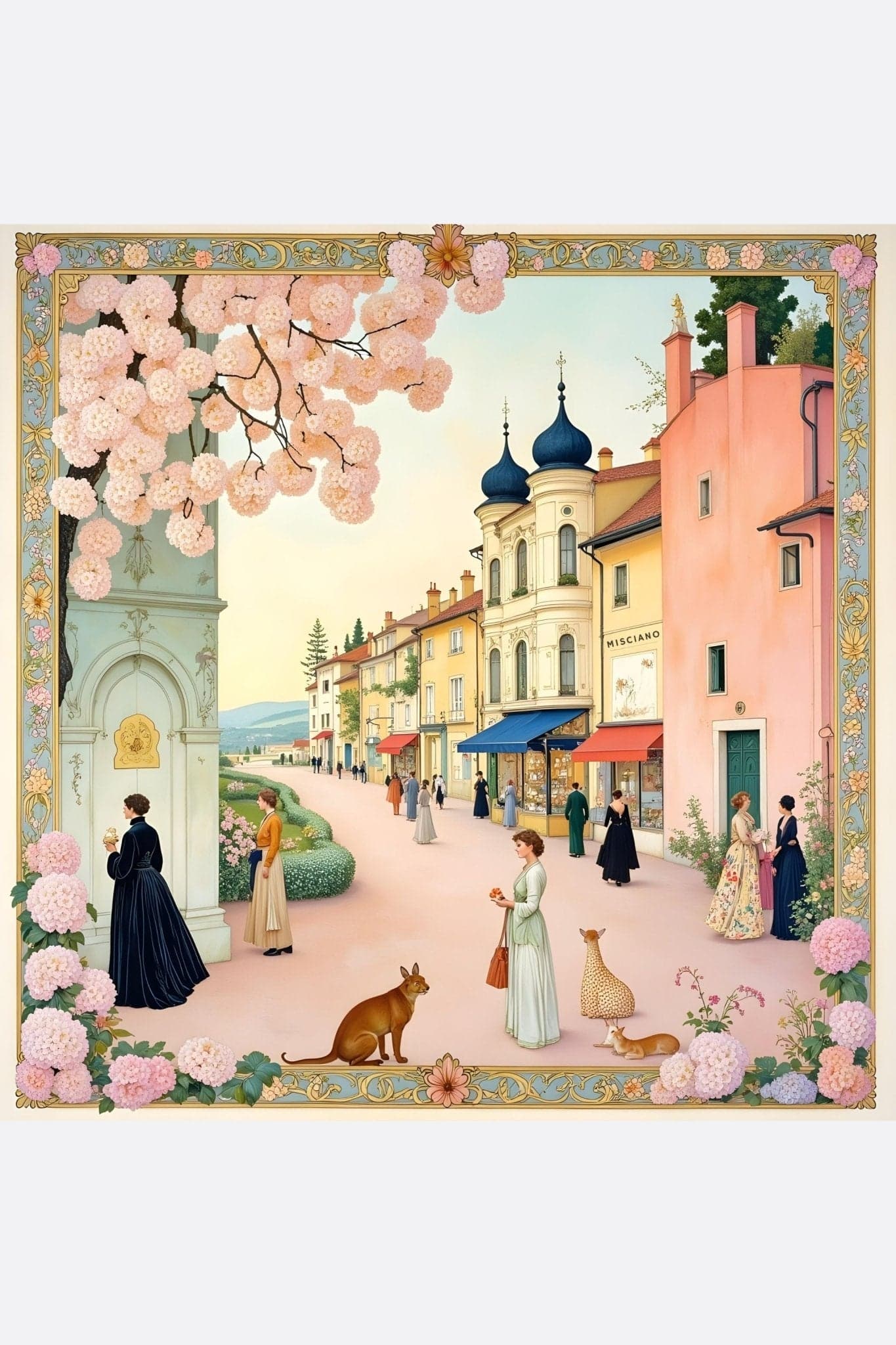
- Silk Scarf 'Promenade à Misciano' – an article dedicated to a pattern and its shaping in the collection.
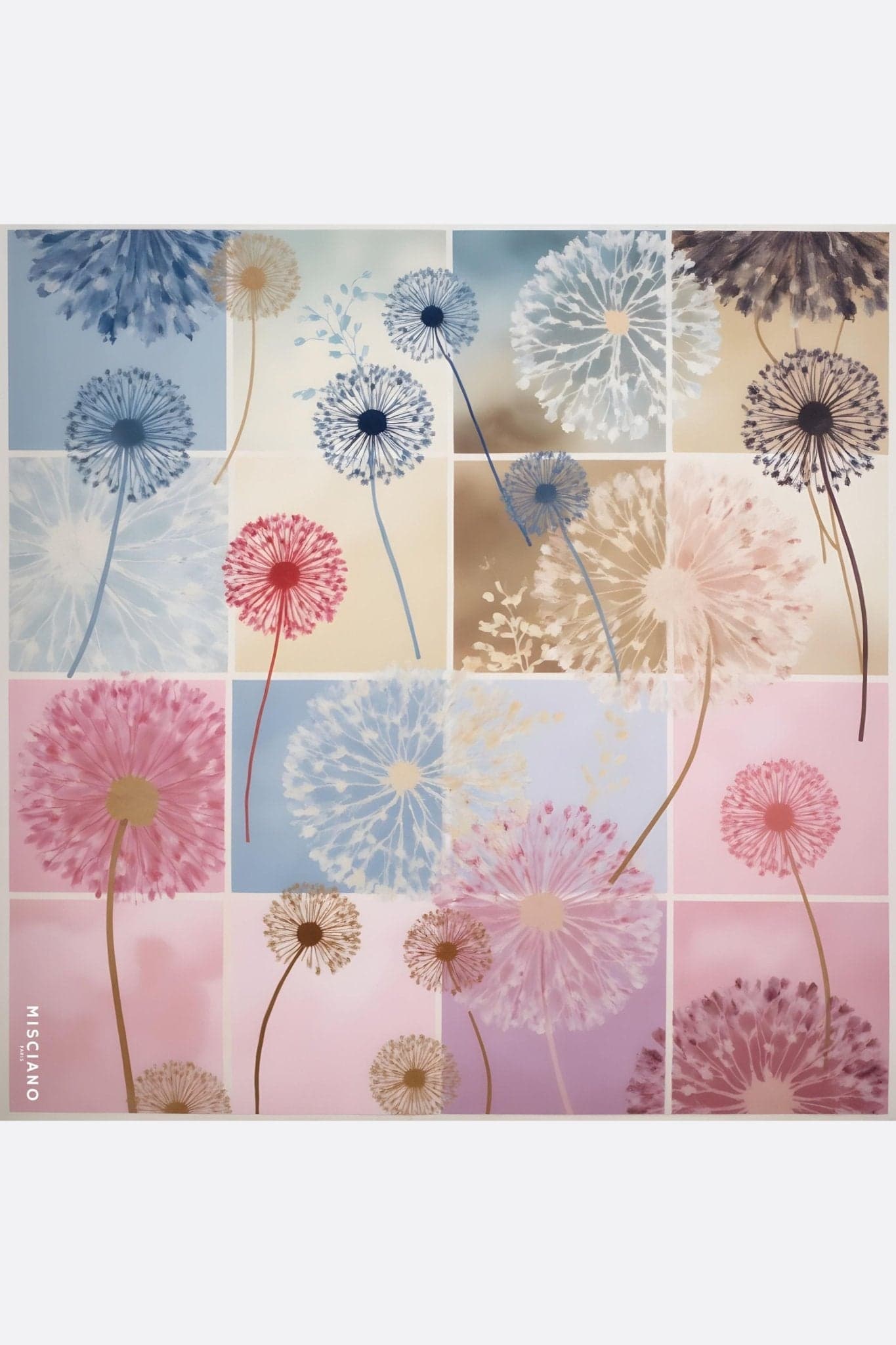
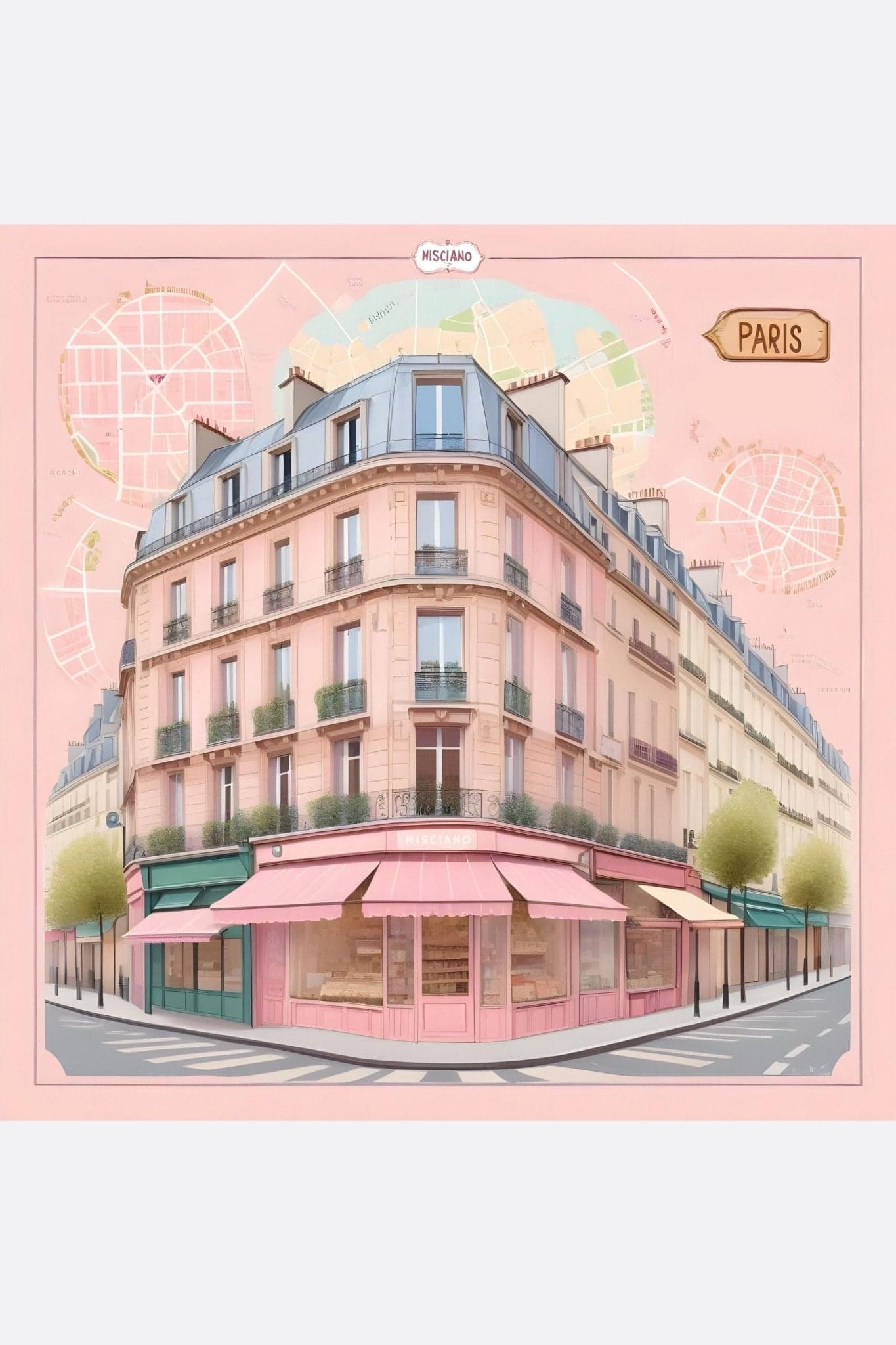
- Silk Scarf Collection – the page of our creations in printed natural silk and hand-rolled hems, to see these principles in material and cut.
These complementary contents allow you to link historical and technical theory to concrete examples of pieces and ways to wear the silk scarf, thus enriching your experience and critical eye when choosing or wearing.

Article by Alberto Alagna
Published on 20/01/2026 at 08:28
About the author
Passionate about textile craftsmanship and sustainable design, Alberto Alagna brings to Misciano a vision where elegance meets ethics. With his experience in high-end ready-to-wear, he shares here his style advice and the behind-the-scenes of the Misciano house.
→ Learn more about Alberto AlagnaFREQUENTLY ASKED QUESTIONS
What are the origins of the silk scarf and how has it evolved over time?
The silk scarf finds its roots in the ancient silk roads, where material and craftsmanship combined to give birth to an iconic accessory. Over time, it was adopted by French fashion, transforming into a symbol of luxury and elegance. This evolution reflects not only stylistic changes but also a constant respect for quality and craftsmanship.
Why is the textile language of the silk scarf often considered ceremonial?
The silk scarf is perceived as ceremonial due to its rich history and its association with significant moments. Its creation requires precision and mastery, resulting in a refined aesthetic. This formal character is reinforced by its unique graphic codes, making each piece a true testament to craftsmanship.
What are the details to observe when choosing a silk scarf?
When purchasing a silk scarf, it is essential to pay attention to several details: the quality of the hand, the rolled edges, and the density of the material. These elements influence not only the appearance but also the durability of the accessory. Attention to these characteristics can enrich the shopping experience and ensure a choice piece.
How can prints on silk scarves affect their visual perception?
Prints on silk scarves play a crucial role in their visual perception. Some patterns offer a depth that draws the eye, while others may appear flatter. This variation is due to the printing technique and the quality of the silk, which interact to create unique visual effects, showcasing the workshop's expertise.
What is the importance of workshop gestures in creating a silk scarf?
Workshop gestures are fundamental in creating a silk scarf, as they ensure the quality and authenticity of each piece. Each step, from weaving to printing, requires specific expertise that contributes to the uniqueness of the final product. This respect for artisanal traditions benefits both the aesthetics and the longevity of the accessory.
Our silk squares