
Washing a silk scarf by hand: safe method, correct gestures, and drying without marks
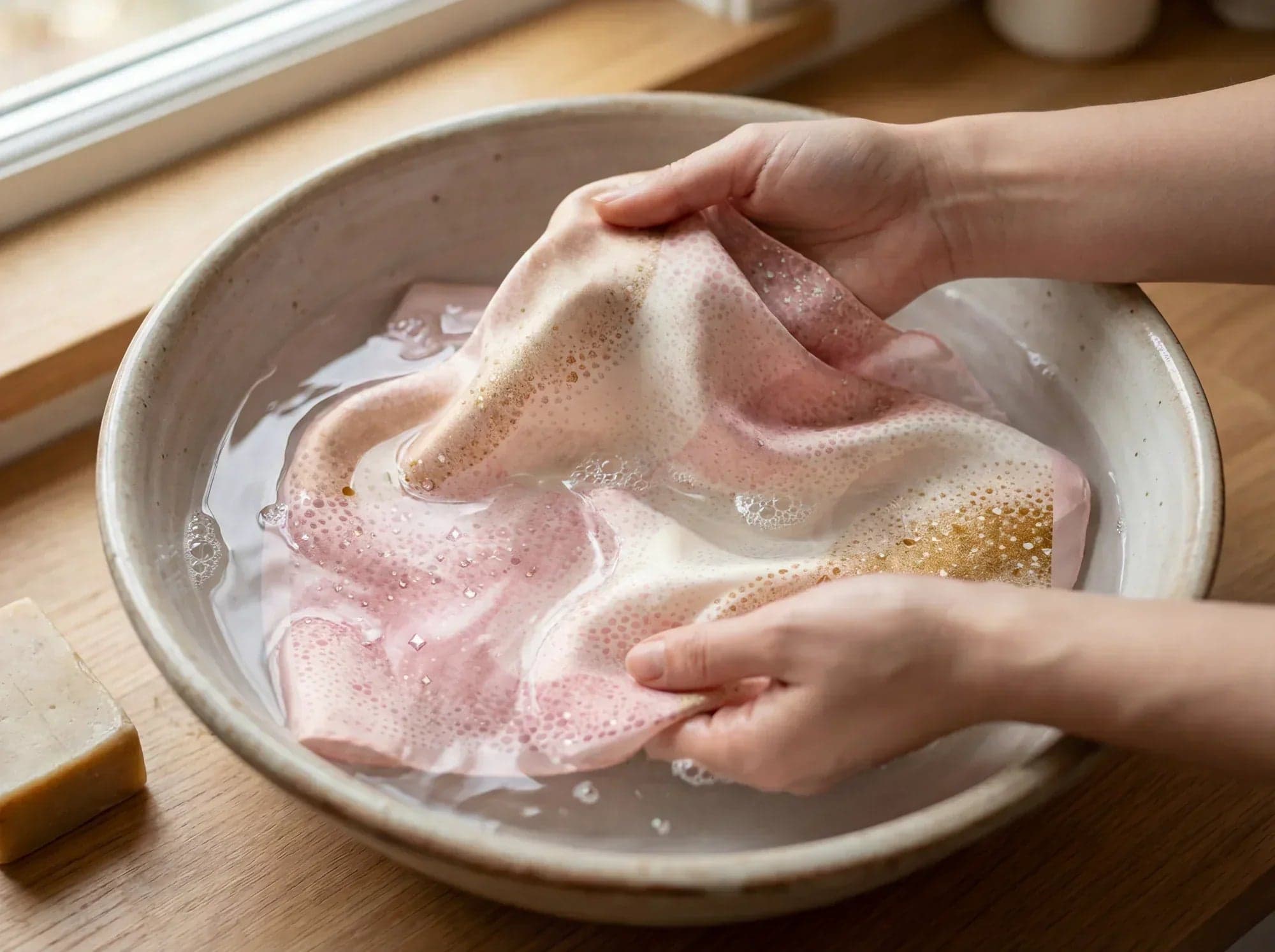
A silk scarf can appear “broken,” tarnished, or marked with halos simply due to a detail: water too hot, unsuitable detergent, friction, too vigorous wringing, or drying in the wrong place. When you want to wash a silk scarf by hand at home, the goal is not to “scrub” like cotton: it is to clean while respecting the fiber, colors, and feel of the fabric.
Silk likes gentle actions, lukewarm-cold water, and minimal handling. Below, I provide a safe, reproducible method with concrete guidelines (temperature, duration, amount of product), as well as the mistakes that create the marks we later regret.
Before starting: Precaution checklist
- Evening dress for women: the Misciano guide to shine with elegance and identify specific mentions (e.g., "dry clean only").
- Test the colorfastness on a small corner of the scarf.
- Check the finishes (delicate prints) and, if necessary, adapt the method.
- Prepare the necessary tools (basin, white terry towel, cotton swab).
Prepare the wash: color test, water at the right temperature, suitable product (no improvisation)
Even before wetting the scarf, preparation makes the difference between an “invisible” wash and a wash that leaves a memory on the material. The first step is to check if the dye can withstand a bath. On a printed scarf, some very pigmented areas (deep blacks, intense reds, midnight blues) may release a bit of color, especially if the scarf has never been washed. To test, moisten a cotton swab or a corner of a white cloth with cold water, press it gently on a corner of the scarf (reverse side if possible) for 10 seconds, then observe: if the white is noticeably tinted, you will need to wash very quickly, with even colder water, and avoid any prolonged soaking. If the color does not move, you can proceed calmly.
Second point: the temperature. Aim for cold to lukewarm water, ideally around 20–25°C. Beyond that, you increase the risk of color migration and alter the “hold” of the silk (it may lose some of its body and luster). Fill a clean basin (without household product residue) with enough water for the scarf to float freely: a compressed fabric washes poorly and marks more easily.
Third point: the product. To wash a silk scarf by hand, choose a very mild liquid detergent, without bleaching agents, aggressive enzymes, “oxygenated” stain removers, and without too strong a fragrance. The ideal is a product formulated for silk/wool, or a special delicate textiles soap. Use sparingly: slightly “slippery” water is enough (often 1 to 2 ml per liter, or half a teaspoon for an average basin). Too much product = endless rinsing = additional handling = risk of marks.
Finally, remove rings and bracelets: a tiny snag can catch a thread. And plan now for a white terry towel (clean) for the absorption step: it’s a detail, but it’s what prevents halos and fixed creases.
Safe method: short bath, “pressing” actions, and clear rinsing to avoid halos
The golden rule: silk does not need to be “worked”, it needs to be passed through soapy water and then rinsed precisely. Immerse the scarf in the basin, let it soak for a few seconds, then perform slow back-and-forth movements, as if you were circulating the fabric in the water. Avoid rubbing two layers against each other: friction is one of the quickest paths to dulling (and sometimes slight pilling on finer silks).
Recommended duration: 2 to 4 minutes of active bathing. If the scarf is simply worn (perfume smell, light urban dust), 2 minutes are enough. If you have an area to refresh (collar, neck contour), you can insist with a local pressing: place the area between your hands and press gently, release, repeat. This gesture replaces rubbing. For greasy stains (foundation mark, sebum), slightly increase the concentration of the bath (always reasonable) and extend by 1 minute, but avoid long soaking: 10–15 minutes on silk is often too much and promotes pigment migration.
Then comes rinsing, a decisive step to avoid marks. Empty the basin, rinse it, then fill with clean cold water. Immerse the scarf and make the same gentle movements. Change the water a second time if necessary. A good sensory marker: at the final rinse, the water should be clear and the fabric should no longer “slip” soapy between the fingers. Even a slight detergent residue can dry leaving matte marks or halos, particularly visible on dark colors.
If you are unsure about the overall care of your scarf (frequency, storage, ironing, snag prevention), bookmark the home guide: Evening dress for women: the Misciano guide to shine with elegance. Here, we remain deliberately focused on the hand washing method, but this link complements the maintenance logic.
Last gesture before taking the scarf out of the water: support it well. Wet silk is heavier and can deform if lifted by a corner. Gather it in a “cradle” in your hands, without pulling. You are already preparing for a clean drying.
Wringing without twisting and drying without marks: the towel, the shade, and the regained shape
Most damage occurs during wringing, not washing. Twisting a silk scarf, even slightly, creates nervous creases that set and can leave lighter areas (the fiber has been “stressed”). After rinsing, press out the excess water while keeping the scarf supported: place it between your palms and apply gentle, progressive pressure. Repeat in several places. The idea is to remove free water, not to “dry” the fabric.
Then, use the safest technique at home: towel absorption. Spread a clean white terry towel flat. Lay the scarf on it, without pulling, and reposition it into a regular shape (edges aligned, corners approximately in place). Cover with a second towel or fold the first one, then roll the whole into a sausage. Gently press the roll with your hands, or by leaning with your body weight (without force). In 30 to 60 seconds, the towel absorbs a large part of the moisture, drastically reducing drying time and, above all, the risk of halos.
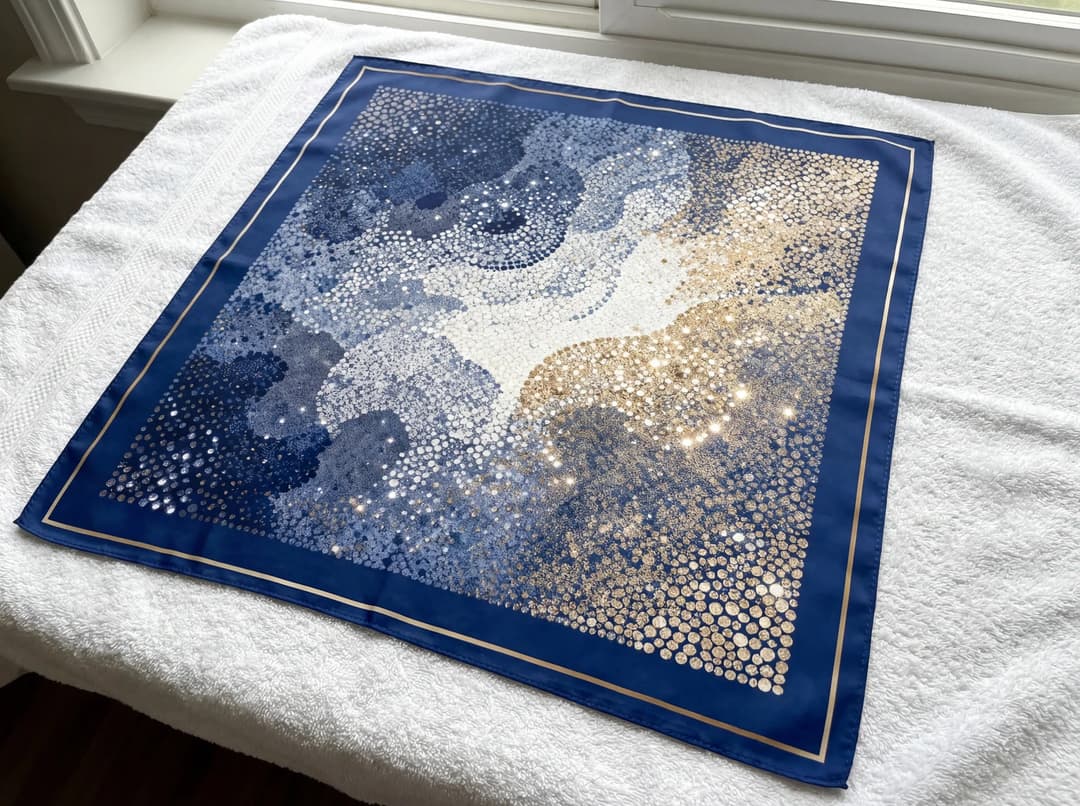
For drying, favor shade and air. Direct light (sun, very bright windowsill) can dull some colors and stiffen the hand. Also avoid the radiator and hairdryer: spot heat can create matte areas. The ideal: flat drying on a dry towel, in a ventilated room. If you lack space and need to hang, do so only when the scarf is already well pre-wrung with the towel, and use a support that does not pinch the material (no clothespin that leaves a bite mark). A suspension by a wide fold on a thick hanger, covered with fabric, limits marks, but flat drying remains the cleanest.
During drying, reposition the edges once if necessary: silk “settles” as it dries. A simple smoothing with the palm of the hand is enough. You should feel the material becoming lighter, almost fresh to the touch, without very damp cold areas: these areas are the ones that sometimes create halos if left compressed.
When the scarf is dry, do not store it immediately in a ball: let it breathe for a few minutes. Silk retains a tactile memory; a peaceful end of drying gives a neater and more lively drape.
Finishing: gentle ironing (or steam at a distance), and common mistakes that damage the luster
After successfully maintaining your silk scarf by hand, the finishing should remain in the same logic: little constraint, a lot of precision. If your scarf has dried flat, it may be almost ready to wear, with only a slight relief on the folds. To achieve a smooth surface without “glazing” the silk, iron on the reverse side, at a low temperature (silk/delicate mode), ideally when the scarf is still very slightly damp or after leaving it for a few minutes in a warm bathroom (ambient humidity). Use a pressing cloth (thin white cloth) if your iron tends to stick or if you fear localized shine.
Steam can be useful, but with distance: hold the steamer 10–15 cm away, and do not saturate the material. Steam too close can create droplets, thus water spots, thus marks. Work the scarf laid flat or on a wide support, with slow movements. If you iron, avoid “pulling” on the edges to straighten them: you risk deforming the scarf. Prefer gentle smoothing, accompanying the fabric.
Here are the most common mistakes (and what they cause):
- Hot water: colors that bleed, loss of print sharpness, less supple feel.
- Long soaking: risk of halos and dye bleeding, especially on dark areas.
- “Classic” detergent: dulling, residues difficult to rinse, less crisp feel.
- Rubbing: more matte appearance, micro-wear, sometimes small fuzzy areas.
- Twisting during spinning: set creases, deformation, permanent marks.
- Drying in the sun / on a radiator: loss of color depth, stiffness, marks.
If you have a localized stain (perfume, makeup), resist the urge to “treat” it like a spot on a t-shirt. On silk, aggressive stain removal often does more damage than the stain itself. Prefer a short and gentle bath, repeated a second time if necessary, rather than a direct attack with concentrated soap. And if the scarf has sentimental value or a particularly delicate print, caution sometimes means entrusting the cleaning to a specialist.
According to the recommendations of several manufacturers and labels of delicate textiles, it is advisable to adapt the method to the specificities of Evening dress for women: the Misciano guide to shine with elegance (twill, satin, crêpe de Chine, or wild silk) and to consult, in case of doubt, a specialized professional.
This guide does not replace the care label attached to your scarf.
By respecting these gestures, the desired result is simple: a clean scarf, without too much residual fragrance, with a supple feel and intact shine, as if the wash had left no trace, except that of a distinctly refreshed fabric.

Article by Maryna Svistunova
Published on 20/01/2026 at 09:06
About the author
I am the editorial director of Misciano Paris. I define the editorial line with the conviction that fashion must be timeless, with rigor, coherence, and sincerity.
→ Learn more about Maryna SvistunovaFREQUENTLY ASKED QUESTIONS
What water temperature should be used to hand wash a silk scarf without damaging it?
To hand wash a silk scarf, the water should be cold or barely lukewarm, ideally around 20 °C. Water that is too hot weakens the fiber, alters the drape, and can cause loss of shape or irreversible marks. Silk reacts immediately to temperature changes: a stable temperature helps preserve its smooth surface, natural shine, and the uniformity of the weave throughout the wash.
What type of soap is safest for hand washing a silk scarf?
A silk scarf should be washed only with a mild soap, formulated without alkaline agents or harsh enzymes. A small amount is sufficient: silk does not retain odors but quickly shows excess product. A soap that is too detergent can stiffen the fiber and leave visible residues when drying, which affects the fluidity and clarity of the pattern.
What actions should absolutely be avoided when hand washing a silk scarf?
Avoid any rubbing, twisting, or vigorous kneading. Wet silk temporarily loses strength: pressing or twisting it breaks the weave's regularity and creates pronounced creases. Movements should remain slow and enveloping, allowing the fabric to glide in the water. This approach respects the fiber's surface and preserves the scarf's natural drape.
How to rinse a silk scarf by hand without leaving marks?
Rinsing should be done in clear water, at a temperature similar to that of washing. It is important to change the water without thermal shock and to let the scarf shed the soap by simple immersion. Rinsing too quickly or under a direct jet promotes halos and tension marks visible once dry.
What is the correct method to dry a silk scarf without creating halos?
After washing, the silk scarf should be drained without being twisted, then laid flat on a clean towel. Air drying, away from the sun and heat sources, allows for even evaporation. Hanging the silk while still damp or letting it dry unevenly often creates visible marks that alter the fabric's clarity.
Our silk squares