How to choose a clothing fabric without getting it wrong
What Exactly Is a Garment Fabric
Understanding What Really Makes a Fabric
Saying "100% cotton" is not enough to understand how a fabric behaves. The fiber is only the starting point. Between the nature of the fiber (cotton, wool, silk), the way it is spun, the weave chosen (plain, twill), the construction (woven or knit, like jersey) and the finishing treatments (dyeing, mercerizing, washing), each step profoundly transforms the final result.
Understanding "Fabric": A Simple Word for a Technical Reality
When we say "fabric," we often think of a single element: the composition (cotton, wool, silk, polyester). Yet, in the workshop as in the fitting room, a garment's fabric is the result of a complete chain: the fiber (the origin), the yarn (the transformation), the structure (weaving or knitting), then the finishing (the treatments). It is this combination that determines the feel to the touch, the fluidity, the structure, the opacity, the durability, the wrinkling, and even the way color settles and ages.
In other words: reading "100% cotton" on a label does not yet tell you whether you will get a crisp, structured fabric, or conversely one that is soft, stretchy, and prone to pilling. Cotton is only a starting point. To choose a garment fabric wisely, you need to learn to distinguish the technical layers that create the final result.

Fiber, Yarn, Weave, Knit: The Building Blocks That Change Everything
The fiber is the raw material: cotton, wool, linen, silk, viscose, polyester… Each fiber has natural properties (absorption, insulation, elasticity, luster). But these properties can be amplified or toned down by the way it is processed.
Designers like Inès de la Fressange use a variety of fabrics to create pieces that combine comfort and aesthetics. Her approach to style highlights the importance of fabric quality in modern fashion.
The yarn is the spun fiber. Its quality depends on the length of the fibers (staple), regularity, twist (more or less tight), and count (finer or thicker). A fine, regular yarn will produce a smoother, more lustrous fabric, often more elegant to the eye. A thicker or more irregular yarn can add texture, a more textured charm, but also more friction and sometimes more visible wear.
The weave refers to the way yarns cross each other in a woven fabric. Three main families structure most fabrics: plain weave (simple, stable), twill (diagonals, softer and more durable), satin (floats, more lustrous, more fluid). With the same fiber, the weave changes the hand feel and drape.
The knit (jersey, interlock, rib…) is a loop-based construction, not a crossing one. It often provides more stretch and comfort, but can also show more marks, deform more easily, or pill depending on the yarn and finishes. A "100% cotton" knit does not have the same presence as a "100% cotton" woven.
The minimalist style of Charlotte Gainsbourg illustrates this approach: few pieces, but the right fabrics.
Every Misciano creation is the result of demanding craftsmanship and meticulous material selection. Our quality commitment translates into elegant, durable pieces designed to enhance every silhouette with naturalness and refinement.
Discover our commitmentFinishing: the final touch that determines how it wears
After weaving or knitting, the fabric is finished: washes, dyeing, printing, dressing, mercerizing, brushing, calendering… These processes can make a material softer, more stable, shinier, matte, more wrinkle-resistant, or conversely more lively and natural.
Mercerizing, for example, is a classic cotton finish that increases luster, strength, and dye absorption. Mercerized cotton can appear crisper, brighter, and often more "dressed up" than non-mercerized cotton, even with identical composition.
Conversely, a "washed" cotton (garment wash type) can gain softness and immediate comfort but lose some structure. Neither is superior in absolute terms: it all depends on the use and the balance sought.
Why two "100% cotton" fabrics can behave in opposite ways
Let's imagine two pieces labeled "100% cotton":
Case A: a cotton woven as poplin, fine yarns, tight plain weave, lightly dressed finish. Result: a smooth, crisp, fresh fabric that holds its shape, ideal for a structured shirt. It wrinkles, yes, but with a "clean," readable crease that sometimes adds to the charm of a well-cut piece.
Case B: a cotton jersey, fluffier yarn, soft knit. Result: a comfortable material, more stretchy, more prone to pilling, that hugs the body. It can show marks more (underwear, folds), and its structure depends on the weight (grammage) and the stability of the knit.
Both are "cotton." But when worn, they are two different worlds: poplin defines a silhouette, jersey follows movement. One evokes precision, the other fluidity.

Misciano case: same fiber, two looks (poplin vs jersey)
We like to remind that a fiber is an alphabet, not a sentence. Take a cotton poplin shirt: when touched, you feel a crisp freshness, a subtle almost "papery" rustle, a smooth surface that catches light without shining. The collar sits well, the cuff stays precise, the shoulder line keeps its clarity.
Next to it, a cotton jersey top: the hand feel is rounder, more enveloping. The fabric folds without resistance, follows breathing, accompanies movement. Light diffuses, more matte. On skin, comfort is immediate, but the material will sometimes demand more attention: avoid repeated friction (bag, rough belt), watch for stretching, and choose a sufficient weight to maintain balance.
This comparison is essential for learning how to choose a garment fabric: you're not just choosing a fiber, you're choosing a behavior.
To go further, discover which fabric suits your body shape to enhance your silhouette.
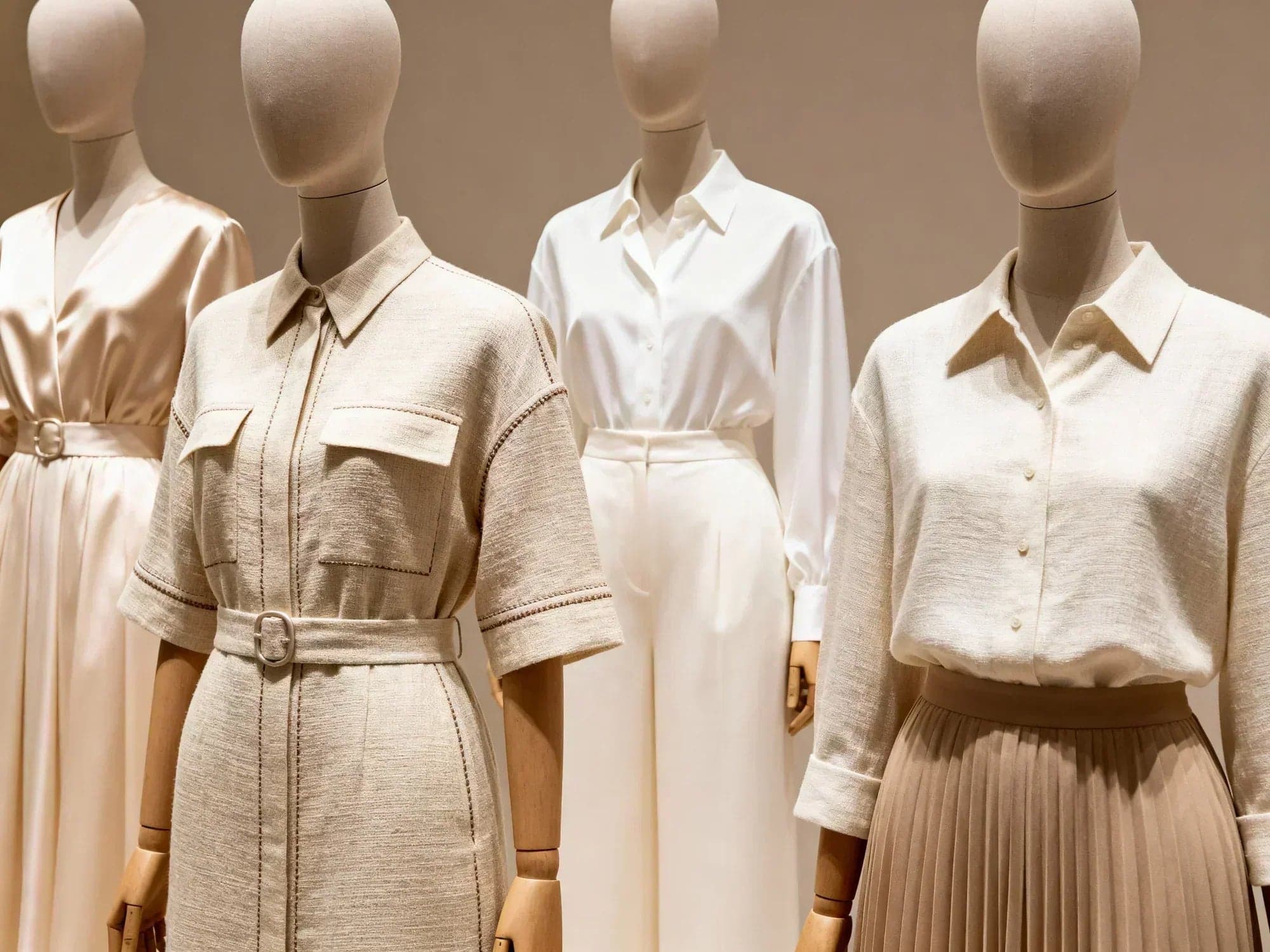
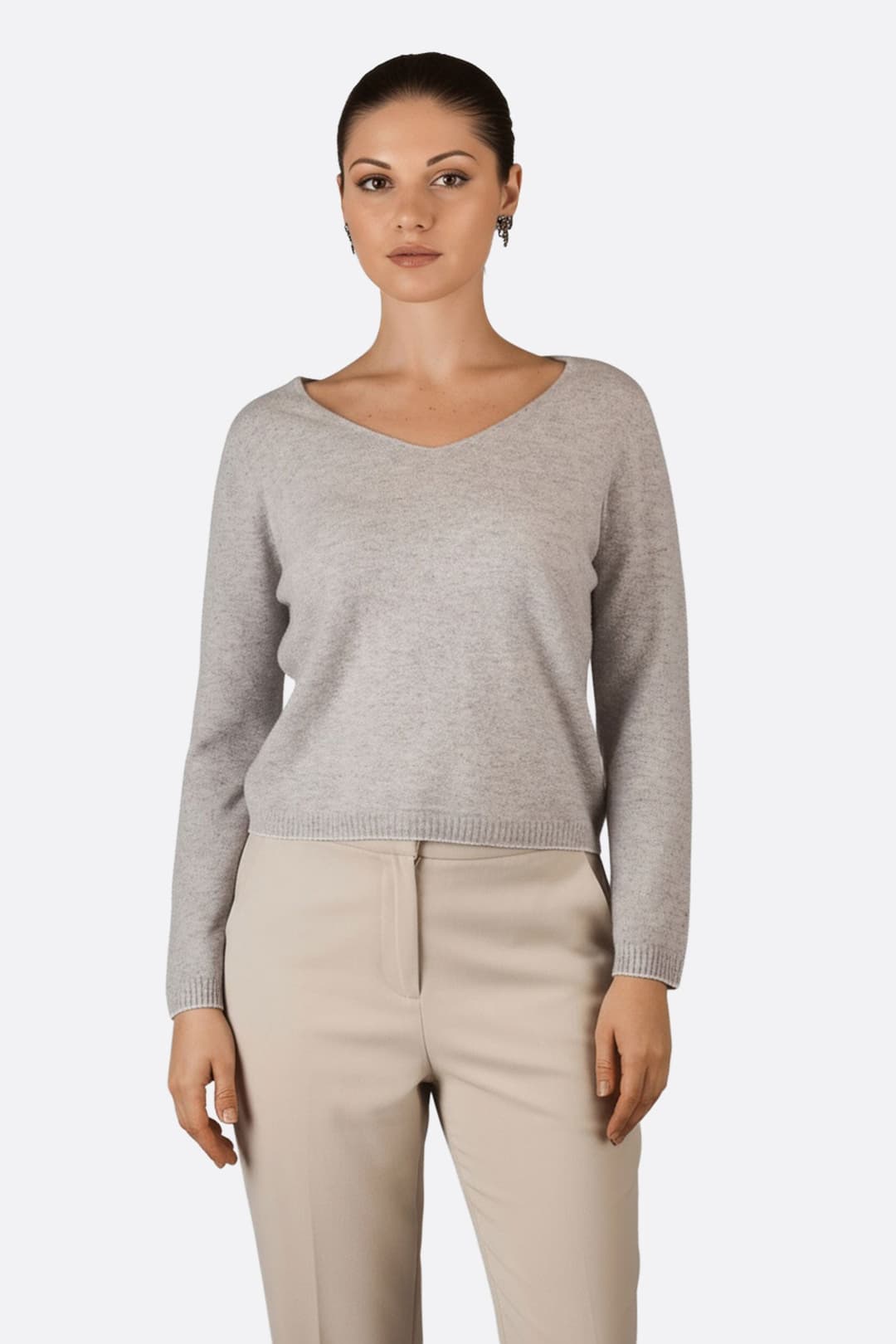
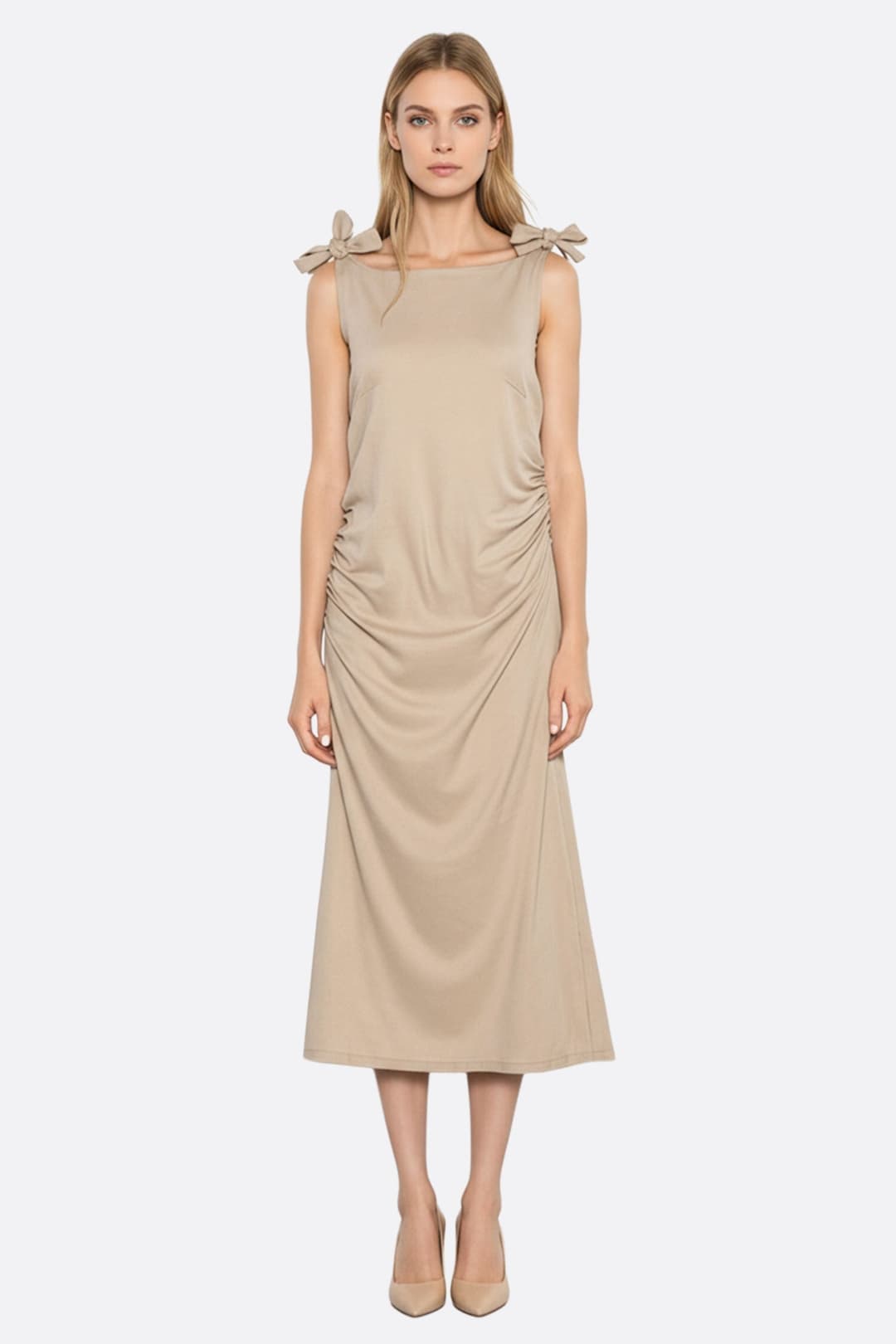
Three fabrics, three pieces from the house
What criteria to look at before even checking the composition
Reading a fabric before wearing it
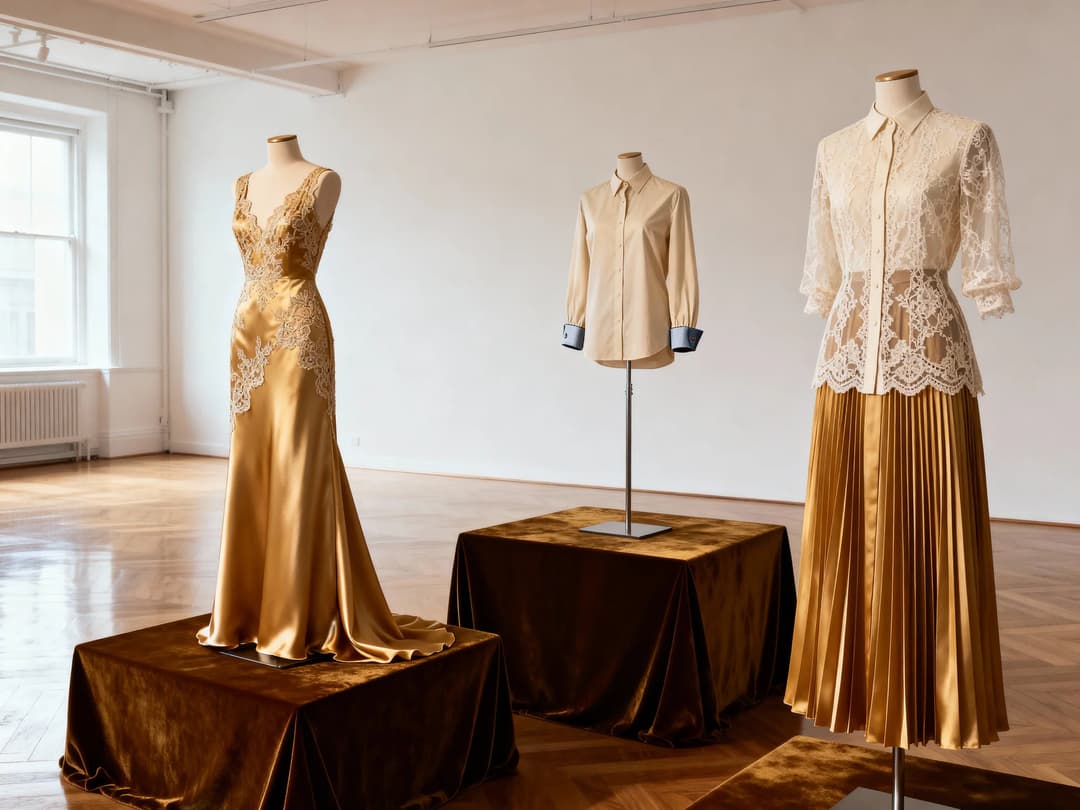
The quality of a fabric reveals itself through a few simple gestures. In the fitting room, five tests are enough to understand its real behavior: pinching to judge the hand feel, rubbing to assess durability and pilling risk, twisting to anticipate wrinkling, holding it up to the light to check opacity, and stretching to measure the fabric's natural elasticity.
These micro-tests, quick and accessible, give a far more reliable reading than a simple mention on the label.Indeed, the label deserves careful attention: the composition of the main fabric, that of any lining, or the presence of a coating directly influence comfort, breathability, and how the piece behaves when worn.
A simple indicator helps anticipate daily use: if the fabric clearly retains a crease after three seconds, you'll need to plan for more regular care, especially for ironing or travel. These observations guide every fabric choice, far beyond the percentages shown.
Before the label: what your hands and eyes already know
Composition is useful, but it never replaces observation. In the store, you have an advantage: you can assess the fabric the way a workshop would, with simple gestures. That's often where a successful purchase is decided.
A fabric can look "beautiful" on a hanger and turn out to be demanding in daily wear; conversely, a discreet fabric can become an everyday ally if it drapes well and wears well.
Here are the 5 criteria to look at before even reading the label: hand (feel), drape, opacity, wrinkling, elasticity. And above all: how these criteria align with your actual use (office, walking, commuting, travel, ceremonies).
The 5 quick fitting-room tests: a reliable method
1) The pinch test (hand and density)
Pinch the fabric between your thumb and index finger, then release. A dense fabric often comes back with more "presence." A fabric that is too soft may lack structure on certain cuts (collar, button placket, lapels) unless supported by interfacing or a lining. The pinch also tells you about fineness: a very fine fabric can be delicate, sheer, or show marks more easily.
2) The rubbing test (surface, potential pilling)
Gently rub the fabric with your palm for 10 to 20 seconds, always in the same spot. Observe: do small fibers rise to the surface? Does the surface become more "blurry"? This test doesn't replace a lab, but it does raise a red flag. Fuzzy knits, certain viscose fabrics, and some blends with short fibers can pill faster, especially in friction areas (hips, underarms, shoulder straps).
3) The twist test (wrinkling and memory)
Lightly twist a section of the fabric, hold for 2 to 3 seconds, then release. If creases remain very pronounced, the fabric will have strong memory: it will wrinkle easily and require more care. If it relaxes quickly, it will be simpler for everyday wear.
4) The light test (opacity and structure)
Hold the fabric up to a light source (fitting room, window, phone flash). Look at the opacity, but also the regularity of the weave: do you see irregularities or thinner areas? For a light-colored dress or summer trousers, this step is decisive. A fabric can be comfortable and breathable, yet too sheer for your comfort.
5) The stretch test (elasticity and recovery)
Gently stretch horizontally and then vertically. A knit stretches naturally; a woven may stretch slightly on the bias. Observe the recovery: does it spring back into place or does it stay stretched out? A fabric that "stays" risks losing its shape at the knees, elbows, and seat.
Note: These tests are qualitative indicators performed in the fitting room and should be considered as analytical guidelines. Their results may vary depending on the technical treatments applied to fabrics (wrinkle-resistant finishes, mercerization, etc.).
Reading the label: composition vs. lining vs. coating
Before even reading the percentages, identify what isn't the main fabric but changes everything when worn:
The lining: a dress can be made of pleasant viscose but lined with non-breathable polyester. Result: a warmer feeling, sometimes static, and less comfort in summer. Conversely, a cupro/viscose lining can improve glide and breathability.
The coating: a fabric can be "cotton" but coated for a waxed, water-repellent, or stiffened effect. The look is superb, but breathability decreases, noise can increase, and creases sometimes become more visible. It's a choice of style and use.
The interfacings (collar, waistband, facings): invisible, but essential. A soft fabric can be enhanced by a well-chosen interfacing; a noble fabric can be let down by one that is too stiff and breaks the fluidity.
The simple indicator: the 3-second crease test
A very concrete reference: fold the fabric in your hand, press lightly for 3 seconds, then release. If the mark remains clearly visible, anticipate:
- More frequent ironing or steaming before going out,
- Trickier transport (suitcase, bag),
- Sitting: creases at the hip crease, behind the knees, at the lower back.
This isn't a death sentence: some wrinkle-prone fabrics are magnificent (linen, certain silks, certain cottons). But it's a conscious choice. Refinement is also about buying with knowledge of the garment's real life.

Garment construction: when the fabric becomes an atelier choice
Before being worn, a Misciano piece is first conceived in the workshop. The choice of material is part of a precise chain: fabric selection, drape tests, weight validation, compatibility with the cut and finishes. The same fabric may be kept or set aside depending on how it reacts to stitching, thread tension, or the final assembly. Understanding the making of a piece means understanding why certain materials are favored for their stability, durability, and fit when worn, far beyond their simple composition.
How to read a label without being fooled
Learning to read beyond the percentages
On a label, the order and proportion of fibers matter as much as their nature. A fabric advertised as 95/5 will have neither the same comfort nor the same hold as a 60/40 blend: in the first case, the dominant fiber clearly dictates its behavior; in the second, the balance between materials noticeably alters the softness, breathability, and stability of the garment. Reading the percentages is already anticipating how it will feel when worn.
Some formulations, however, can be misleading. A mention of "silk" may only refer to the lining, "wool" may be present in a marginal proportion, and the term "leather" can sometimes designate a simple coating.
These nuances are not mere details: they change the perception, care, and durability of the piece. Transparency goes further: when the information is available, the fabric weight and country of weaving are also indicated, to provide a complete and honest reading of the material, beyond words and marketing effects.
Descending order: the rule that changes how you read
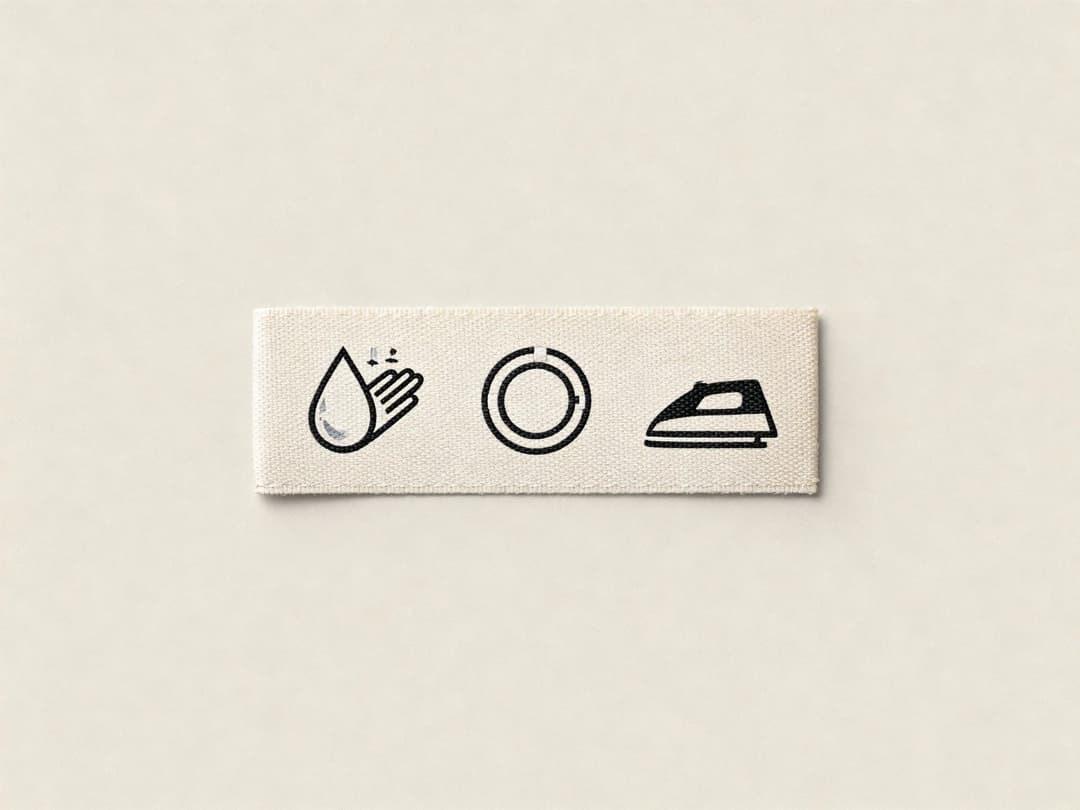
On a label, fibers are listed in descending order. The first fiber is the majority, therefore structural. But percentages matter as much as order: a blend may be designed to correct a flaw, or conversely to reduce cost at the expense of comfort.
Understanding how to choose a clothing material involves interpreting the ratios:
95/5 (e.g., 95% cotton, 5% elastane): the main fiber clearly dominates. The 5% often serves to provide comfort, ease, and better shape recovery. On trousers or a skirt, this can improve hold throughout the day.
60/40 (e.g., 60% wool, 40% polyester): this is a real balance. Polyester will have a noticeable impact: less wrinkling, more resistance, sometimes more perceived warmth, sometimes less breathability. This can be excellent for a mid-season coat or travel trousers, but less pleasant for a piece worn in a heated indoor setting if the cut is fitted.
What percentages say about comfort and hold
Thermal comfort: a majority of natural fibers (wool, cotton, linen) often aids breathability, but beware: a synthetic lining can cancel out the effect. Comfort comes from the whole.
Hold and wrinkling: synthetic fibers (polyester, nylon) often provide better wrinkle resistance and dimensional stability. But a material that is too "plastic" can lose fluidity and elegance in movement. The balance is found in the touch and drape.
Care: a small proportion of a fiber can dictate the most restrictive care requirements. Example: 10% wool in a blend may be enough to recommend more delicate cleaning depending on the construction and finishes.
Common pitfalls: what the label does not highlight
"Silk" in lining only: sometimes, a piece is sold with talk of silk, while the main material is synthetic, and the silk only appears in the lining (or worse: in a detail). Always check the "Shell / Main fabric" line versus "Lining".
Minority "wool": a coat advertised as "wool" may contain 20% wool and 80% synthetic fibers. This is not necessarily bad, but it is not the same experience: warmth, odor management, drape, aging.
"Leather" vs "coating": some items achieve a leather look through a polyurethane coating on textile. The appearance may be successful, but the patina, breathability, and repairability are completely different. Genuine leather is nourished, repaired, and marked by a story. A coating ages differently: possible cracking, more abrupt wear zones.
"Viscose" and wet fragility: a very fluid viscose can be wonderful to wear, but it can deform or shrink if care is approximate. The care label is your second compass after the composition.
Misciano transparency: weight and weaving country
Two pieces of information are too often missing for the consumer, even though they are decisive:
- Weight (g/m²): it indicates density, opacity, drape, seasonality, durability. Two 100% cotton fabrics can be separated by 60 g/m²... and by a world of use.
- Weaving / knitting country: without being an absolute label, it provides a clue about industrial standards, know-how, and sometimes traceability. When the information is available, it deserves to be displayed.
We are committed to displaying the exact weight on each of our product pages and, when possible, the weaving/knitting country. This transparency, enriched by internal tests and based on commonly used standards (e.g., ISO 12945 for pilling, Martindale for abrasion), helps you buy with precision: not "more expensive," but more accurate.
To go further:
Which natural fibers to choose based on the comfort you're looking for
Cotton: the false obvious choice
Cotton is often chosen "for safety." It's breathable, pleasant, and easy to wear. But its quality and behavior vary enormously. To fully understand how to choose a clothing fabric, remember three levers: yarn count, weave, weight.
Yarn count: a finer, more regular yarn gives smoother cotton, often more elegant, sometimes more fragile if it's too fine for the use. A thicker yarn gives more robust, more casual, sometimes rougher cotton.
Weave: a tight poplin offers ideal crispness for a shirt. An oxford adds texture and controlled casualness. A more open weave breathes better but can become more transparent.
Weight: a light cotton (e.g., certain summer poplins) can be cool, but also transparent in white or light colors. Conversely, a denser cotton drapes better, shows fewer marks, and often ages better on high-stress areas.
To the touch, a beautiful cotton gives a feeling of cleanliness and balance: neither greasy nor excessively "dry." It captures light discreetly.
Wool: smart warmth and drape elegance
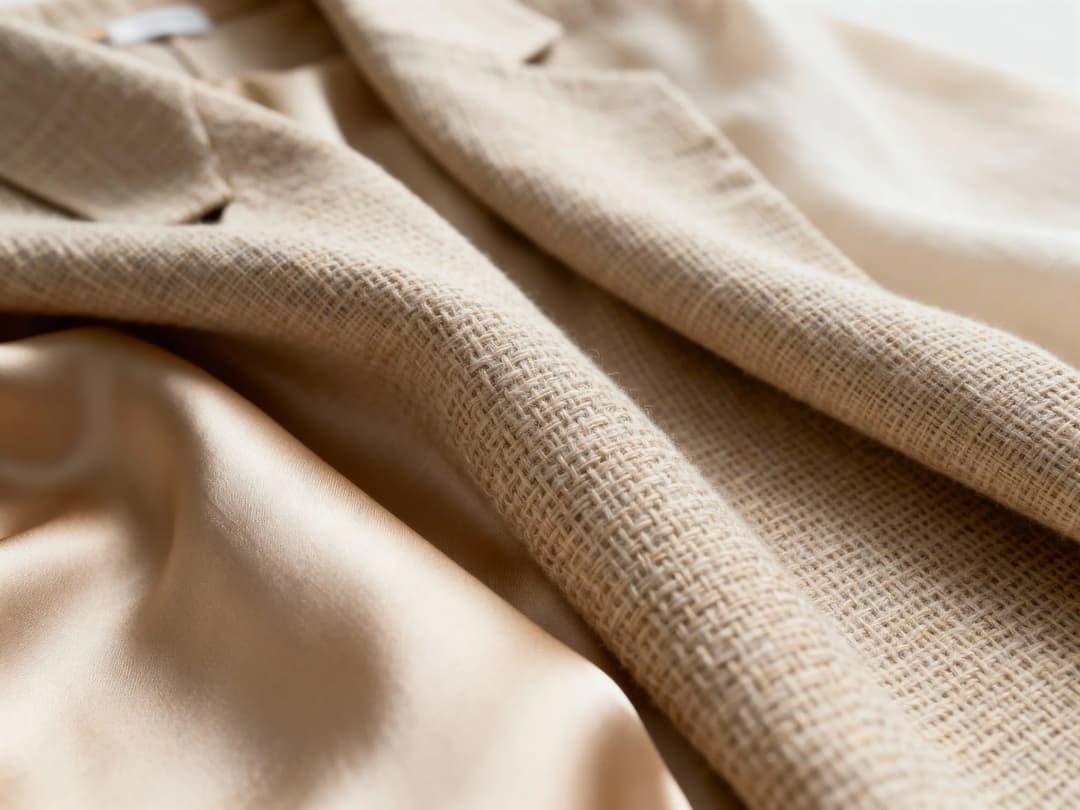
Wool is precious for two reasons: thermoregulation and odor management. It can keep you warm without suffocating, especially when the fabric is well woven and the cut allows for breathability. Contrary to some misconceptions, wool isn't reserved for winter: a cool wool (dry weave, combed yarn) is superb in the office, even in mid-season.
Merino: fine fibers, often softer on the skin, excellent thermal management. In knitwear, it's a refined ally for underlayers and fine knits. Caution: depending on the twist and finish, merino can pill.
Combed wool: aligned fibers, smoother, crisper finish. Widely used for suits and trousers: precise drape, more controlled creasing.
Flannel: brushed wool, softer, more matte, warmer. Its charm is immediate: a velvety light, a depth. It creases a bit more, but with natural elegance.
Wool is also chosen by ear: a cool wool "sounds" drier, a flannel "whispers" softer when rubbed.
Silk: light, fluidity... and demands
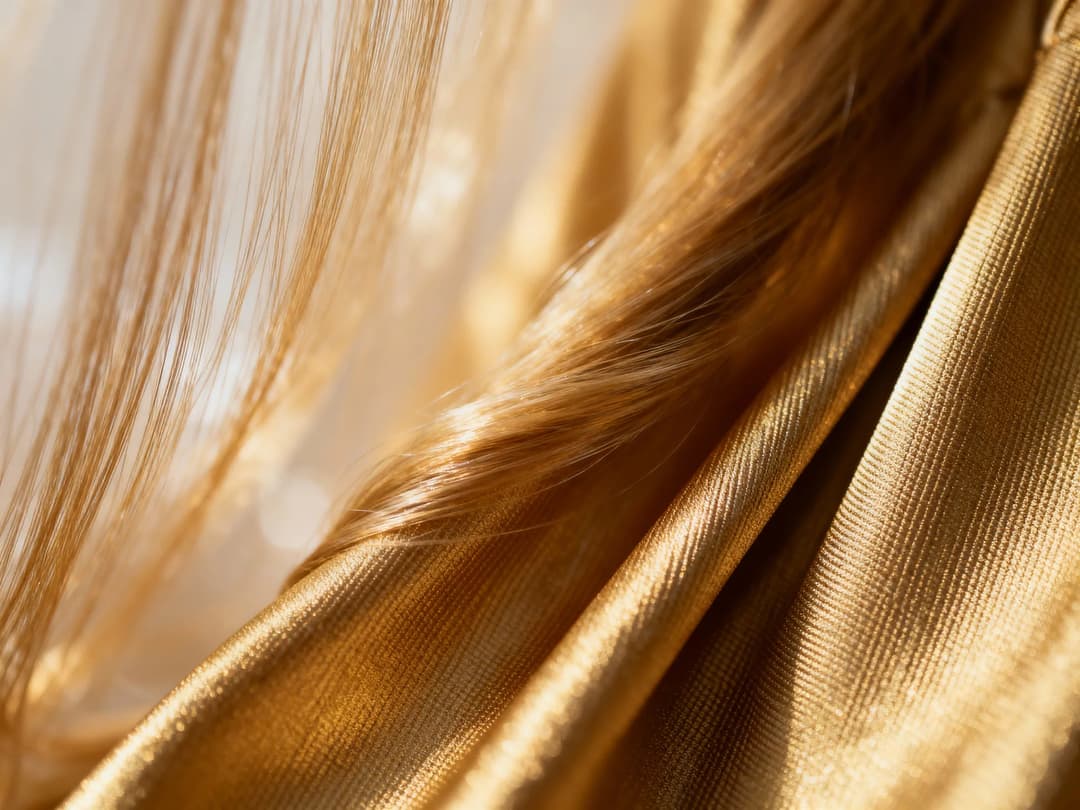
Silk is a fabric of light. It can be shiny (satin), matte (crêpe), textured (dupion), airy (chiffon). Its refinement comes from its ability to follow movement and capture radiance without stiffness.
But silk requires careful consideration:
- Perspiration: some silks mark more easily, especially in summer. Halos can appear depending on the dye and weave.
- Friction: very fine silk can wear out in friction areas (bags, belts, edges). Satins can "shine" in stressed areas.
- Care: many silks require delicate cleaning. Some can be hand-washed, but this depends on the finishes and colors.
A successful silk is recognized by its controlled fluidity: it glides, but does not collapse. It accompanies, without snagging.
Silk by use: when the material becomes a strategic choice
Not all silks are worn the same way, and it is often the use that should guide the choice. A fluid, lightweight silk will be ideal for a silk scarf or a top worn close to the body, where movement and light take precedence, while a more structured silk will bring more hold to a blouse or a piece designed to frame the silhouette.
The question is therefore not only aesthetic, but functional: thermal comfort, sensitivity to wrinkling, reaction to perspiration, and behavior over time.
To delve deeper into these differences, it is useful to refer to concrete examples of silk pieces, to specific care guides, or to articles that explain how to wear silk daily without unnecessary constraint.
Which artificial and synthetic fibers are really worth it
Artificial fibers: the softness of transformed plant material
Artificial fibers like viscose, lyocell, and modal come from cellulose (often wood), transformed into yarn. They often offer a very pleasant hand feel: coolness, fluidity, soft drape. For a dress that moves, wide-leg pants, a breathable blouse, they can be remarkable.
Viscose: very nice fluidity, often silky touch. Caution: it can wrinkle easily depending on the weave (crepe, lightweight twill), and lose strength when wet. Some viscose shrinks if care is too hot or too aggressive.
Lyocell: often more stable, stronger when wet, with a smooth hand and elegant drape. It can, however, crease at folds depending on the construction. Very pleasant in summer, especially in smart blends (with cotton or linen) to gain texture.
Modal: soft, supple, often used in knitwear. Excellent skin comfort. Watch out for possible pilling if the yarn is fuzzy and the piece undergoes regular friction.
Synthetic fibers: the tool, not the enemy
Polyester and nylon have a bad reputation, sometimes rightly so when used without care. But it would be a mistake to reject them outright. They bring valuable qualities: durability, easy care, strength, quick drying, stability. The key is to choose them in the right place, in the right proportion, and with a construction that remains elegant. Note that high-performance filament polyester variants, when integrated into a breathable structure, can also offer decent breathability.
When it is a good choice:
- Rain: technical trench, windbreaker, water-repellent fabrics.
- Travel: wrinkle-resistant pants, easy-to-roll dresses, quick-drying pieces.
- Sporty chic: skirts, jackets, and tops that require elasticity, strength, and hold.
A well-woven polyester can mimic an elegant crepe, or offer a stable gabardine. But the touch must remain pleasant: a hand that is too "dry" and noisy often betrays average quality.
Elastane: a small percentage, a big impact
Elastane (spandex) is rarely the majority. It is a supporting fiber, but it strongly modifies the use. In general:
- 2–5% elastane: improves ease, hold, comfort when seated, and shape recovery.
- Beyond that: the piece becomes more "stretchy," sometimes more form-fitting, and may require an adapted cut.
Use case: on a pencil skirt, 2–5% elastane can prevent the "baggy knees" effect and make walking feel more natural. But depending on the yarn and surface, elastane can also increase pilling: the fabric stretches, fibers loosen, and friction causes pills to appear faster, especially on certain knits or viscose/polyester blends.
The right reflex: do the friction test, and check the surface at the hips and inner thighs (high-wear zones).
Woven or knit: why structure changes everything
Weaving: the garment's invisible architecture
Two fabrics can show the same composition and yet behave completely differently. The structure, woven or knit : is the architecture. It determines strength, drape, wrinkling, and how light plays across the surface.
Plain weave: a simple, very stable weave. Often crisper, "cleaner," sometimes more prone to wrinkling if the fiber is sensitive (cotton, linen). Ideal for shirts, linings, structured pieces.
Twill: recognizable by its diagonal lines. It often offers more flexibility and abrasion resistance. Many trousers and gabardines are twill. It usually wrinkles less than an equivalent plain weave and drapes more softly.
Satin: a weave with floats, smoother and shinier surface. It "glides" over the skin, catches light, and adds fluidity. The downside: it can snag and requires delicate handling.
Knit: comfort, but watch the surface
Knits are built from loops. They are naturally more stretchy, comfortable, and forgiving of body variations. They're a daily ally… if chosen well.
Jersey: soft, often light to medium weight. Very pleasant, but can roll at the edges, lose shape, or pill depending on the yarn.
Interlock: a more stable, denser knit, often higher quality to the touch. It drapes better and shows fewer marks.
Rib: vertical texture, high stretch, often used for fitted tops. It can show underwear lines more and needs good opacity.
With knits, yarn quality and finishing are key: a too-fuzzy surface is more prone to friction damage.
Studio example: satin viscose vs crêpe viscose (same composition)
In the studio, the example is telling: a satin viscose and a crêpe viscose, both 100% viscose.
Satin viscose: smooth surface, crisp glide, more light reflection. It often feels "cooler" on the skin, and it shows fewer light wrinkles because the continuous surface reflects light evenly. However, it can reveal snags and needs care around jewelry and bags.
Crêpe viscose: more textured surface, elegant matte finish, more "lively" movement. But this structure can hold creases more and wrinkle more easily, while better masking small body irregularities thanks to its grain.
Same fiber, two lives. That's exactly why choosing a fabric can't be reduced to a word on the label.
How to choose fabric by season and temperature
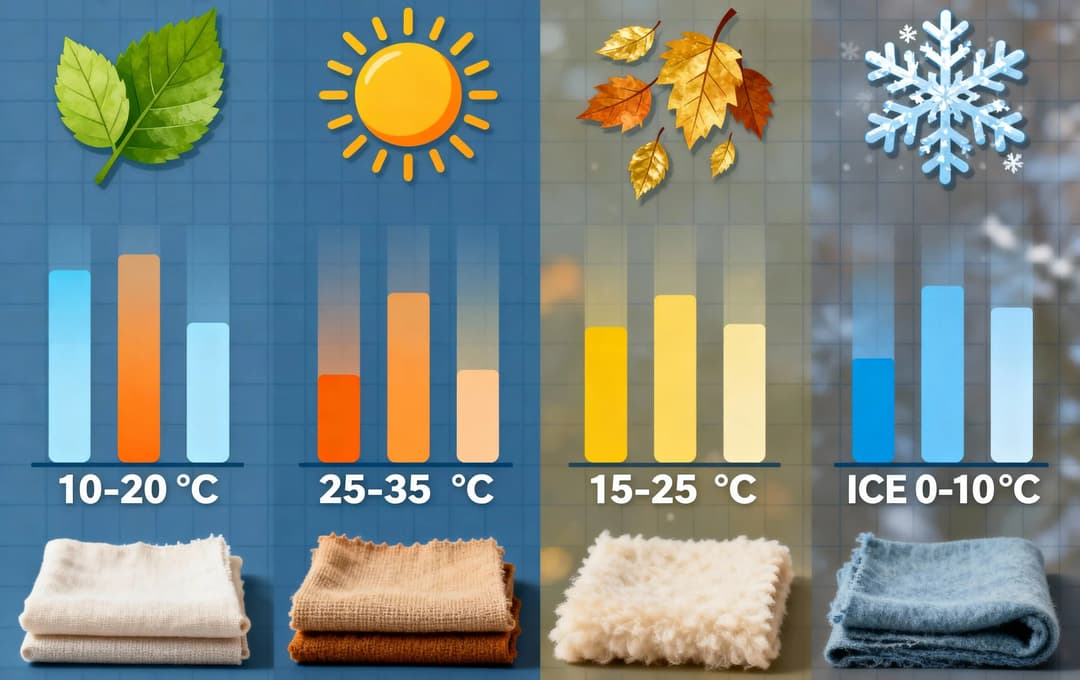
Summer: breathe, dry, let skin live
In summer, comfort comes from two things: breathability and drying ability. Heat isn't just about temperature, it's also humidity, sweat, and friction.
Linen: summer champion. It breathes, dries quickly, offers a lively hand and natural elegance. Yes, it wrinkles, but it's a noble, readable wrinkle. For more structure, look for a linen with sufficient weight, or a linen/cotton blend.
Light cotton: pleasant, but watch opacity. A too-fine white poplin can turn sheer. For shirts and dresses, choose a denser cotton if you want to limit transparency and marks.
Lyocell: excellent in summer for its fluid drape and comfort. On a long dress or wide-leg trousers, it feels cool and moves beautifully.
Avoid the "all synthetic" reflex in peak heat, especially for fitted cuts: breathability may be insufficient, and the feel can become less pleasant as the day goes on. On the other hand, a well-thought-out touch of synthetic can help with wrinkle resistance and drying.
Winter: insulate without suffocating
In winter, the fabric must insulate, but also manage the shift between heated interiors and cold exteriors. Wool is a top ally: it regulates, limits odors, and maintains an elegant drape.
Wool and flannel: perfect for trousers, skirts, jackets. Flannel offers visual and tactile softness with enveloping warmth.
Dense knit: opt for knits with good structure. A knit that is too loose lets air through and loses its shape. A dense knit holds its silhouette and fits better into an elegant wardrobe.
Managing layers: comfort also depends on strategy: a fine merino underlayer beneath a wool jacket, a breathable lining, a dense cotton shirt under a sweater. Choose fabric as a system, not as an isolated piece.
To go further, discover our article on the art of winter layering.
Mid-season: the art of balance and moisture
Mid-season is often the trickiest: humidity, temperature swings, light rain, wind. This is where twill, gabardine, and blends become invaluable.
Twill: more durable, often less prone to wrinkling, with a rounder drape. Excellent for transitional trousers and jackets.
Gabardine: a tightly woven twill, very stable, with great structure. Ideal for trench coats and crisp trousers. It can be made of cotton, wool, or blends.
Smart blends: a touch of synthetic fiber can help reduce wrinkling and manage moisture, without sacrificing comfort if the cut is well thought out and the lining breathes.
Which fabric to choose based on the occasion and level of expectation
Office: the fabric must last through the day
At the office, fabric faces reality: prolonged sitting, repetitive movements, sometimes commuting, and artificial light. The goal: structure, opacity, controlled wrinkling.
Worsted wool: ideal for trousers and jackets. Clean drape, minimal wrinkling, lasting elegance. It gets through the day without sagging.
Twill: excellent for trousers and skirts. Durable, wrinkle-resistant, with a strong presence.
Dense poplin: for shirts, it offers a precision that frames the face and structures the silhouette. Choose a sufficient density to avoid transparency and marks.
Tip: for a light-colored piece, always do the light test. Elegance at the office is also a matter of peace of mind.
Ceremony: light, movement, discreet comfort
A ceremony calls for a fabric that photographs well, moves well, and holds up over several hours. Here, composition matters, but structure matters even more: drape, light, comfort.
Silk: satin for shine, crepe for refined matteness, chiffon for lightness. Watch out for friction (bags, jewelry) and perspiration. A suitable lining can change everything: better glide, better opacity, more comfort.
Satin (silk or high-end synthetic): stunning in a long dress, flowing skirt, or dressy blouse. Satin reveals the cut: it demands precise construction and appropriate undergarments.
Crepe: often more forgiving, it moves well, hides certain marks better, and remains elegant under light.
Travel: the fabric must be an ally, not a constraint
When traveling, you want to roll a dress into a suitcase, walk, switch between hot and cold, and keep a neat look without ironing every morning. The criteria: wrinkling, odors, versatility.
Smart blends: a mostly natural fabric with a synthetic component can be ideal: less wrinkling, more stability, faster drying.
Stable knits (interlock, dense jerseys): comfort, ease, few marks if the weight is sufficient. Perfect for tops, simple dresses, coordinated sets.
Merino wool (fine knit): excellent for limiting odors and regulating temperature. A fine sweater or quality merino t-shirt can become a key piece.
What quality signals to check in store or upon delivery
Fabric weight: the silent indicator of structure
Fabric weight (g/m²) is one of the best indicators of density and structure, but it is rarely communicated. Yet, it helps you anticipate: opacity, drape, seasonality, durability.

Here is an indicative guide (variations are normal depending on fiber and structure):
- Shirt: ~90–140 g/m² (closer to 90 = very light/summer weight, closer to 140 = more opaque and structured)
- Blouse / woven top: ~80–160 g/m² (depending on desired sheerness)
- Fluid dress: ~110–200 g/m² (below this, watch out for opacity and marks)
- Trousers: ~180–320 g/m² (depending on season and structure)
- Jacket: ~220–400 g/m² (excluding lining)
- Coat: ~400–800 g/m² (and sometimes more, depending on drape, double-face, etc.)
These indicative ranges are provided for guidance and are based on references from internal testing as well as international standards, such as ISO 12945 (for pilling) and Martindale (for abrasion). Values may vary depending on structure (woven vs. knit) and applied treatments.
Early pilling test: 20 seconds that prevent regrets
Pilling is one of the most common regrets. In store or upon delivery, do this simple test:
Rub with your palm for 20 seconds on a discreet area (inside, hem). Then observe:
- Do fibers come up?
- Does the surface become cloudy?
- Do micro-pills already appear?
If yes, the piece will likely be sensitive to daily friction. This may be acceptable for an occasional garment, but risky for a "staple" piece worn often.
Seams and allowances: fabric alone is not enough
A noble fabric poorly assembled loses all its value. Look at:
Seam tension: if the fabric puckers along a seam, it is often a sign of tension or poor adjustment. On a fluid fabric, this breaks the line.
Stitch regularity: stitches that are too long on a fine fabric can weaken it. Irregular stitches reveal a lack of precision.
Allowances and inner finishes: on some pieces, an allowance that is too small can limit alterations and weaken the garment. Clean finishes (neat overlocking, French seams, bias binding) improve durability and comfort.
Quality is often visible on the inside. That is where elegance becomes lasting.
The most common mistakes that make you regret a purchase
Mistake #1: buying a percentage instead of a behavior
The most widespread mistake is choosing a garment because it displays a reassuring fiber: "100% cotton," "wool," "silk." But, as you've seen: the fiber is not enough. The weave, the knit, the finishes, the lining, the coating transform how it wears.
A 100% cotton can be sheer and wrinkly, or dense and structured. A wool can be soft and stable, or harsh and fragile. A viscose can be stunning in movement, but demanding to wash. To avoid regrets, always ask yourself: how will this fabric live through my day?
Mistake #2: underestimating care (and its real cost)
A fabric can be perfect… if you accept its care requirements. Many regrets come from this: too-frequent dry cleaning, overly demanding ironing, constraining flat drying, fear of washing.
Before buying, check:
- Cold wash: is it realistic for you?
- Flat drying: do you have the space and time?
- Dry cleaning: what annual budget if you wear the piece often?
A garment worn 30 times a year and regularly pressed has a cost of use. Elegance is also about choosing a fabric that fits into your lifestyle.
Mistake #3: confusing "premium fabric" with "suitable fabric"
A premium fabric is not always the best for you. A beautiful silk is a delight in the evening, but it is not ideal for intensive daily use: friction, perspiration, delicate care.
Conversely, a simpler, well-constructed fabric can be a staple piece: a quality twill, a stable cool wool, a dense, well-finished knit. Refinement comes from the balance between look, comfort, care, and durability.
If you only remember one rule for how to choose a clothing fabric: choose a fabric whose qualities match your actual use, and whose demands won't make you give up wearing it. A beautiful garment that stays in the closet was never a good choice. Our protocol for choosing a durable premium fabric helps you arbitrate between prestige and use.
When looking to go further in choosing a fabric, understanding fabric weight also helps you anticipate its drape, hold, and behavior over time.
Practical conclusion: at your next purchase, do your 5 tests in the fitting room, read the label distinguishing main fabric/lining/coating, look for structural clues (weave or knit), and project the care. You'll buy less "at random," and much more accurately.
To go further:
- To go further and compare each fabric according to your priority criteria, our complete textile materials comparison
Reading a composition label in thirty seconds
On a label, fibers are listed in descending order, and the highest percentage dictates most of the behavior. A "95% viscose, 5% elastane" wears like a viscose: fluid, pleasant against the skin, prone to wrinkling. The same 5% elastane in a polyester gives a dress that doesn't wrinkle but breathes less. Elastane doesn't change the nature of the fabric; it adds shape recovery.
The most common trap is stopping at the first line. A dress advertises a nice viscose, and its lining is a fine polyester: it's the lining that touches the skin, it's what sticks in summer and picks up static electricity. Always read the "lining" line, then "trims." A mention of silk or wool may only concern a detail.
At Misciano, the composition is listed on every product page, lining included when there is one. That's the first filter. The second is the drape, and for that you need to look at the piece worn, not on a hanger: our photos on models are there for that.
Choosing the fabric according to your silhouette and the desired drape
A garment that "has a life of its own" once worn, that clings where it shouldn't or stiffens the line, is almost never a body issue. It's a fabric that doesn't suit the area it covers. The drape plays out locally: a fabric perfect on the bust can be unforgiving on the hips.
Four parameters decide the result, far more than the fiber name: weight (a heavy fabric falls straight and smooths volumes), suppleness (a soft hand follows the body, a dry hand holds its line), elasticity (it forgives variations but hugs everything), and the surface, matte or shiny (shine enlarges what it illuminates, matte soothes).
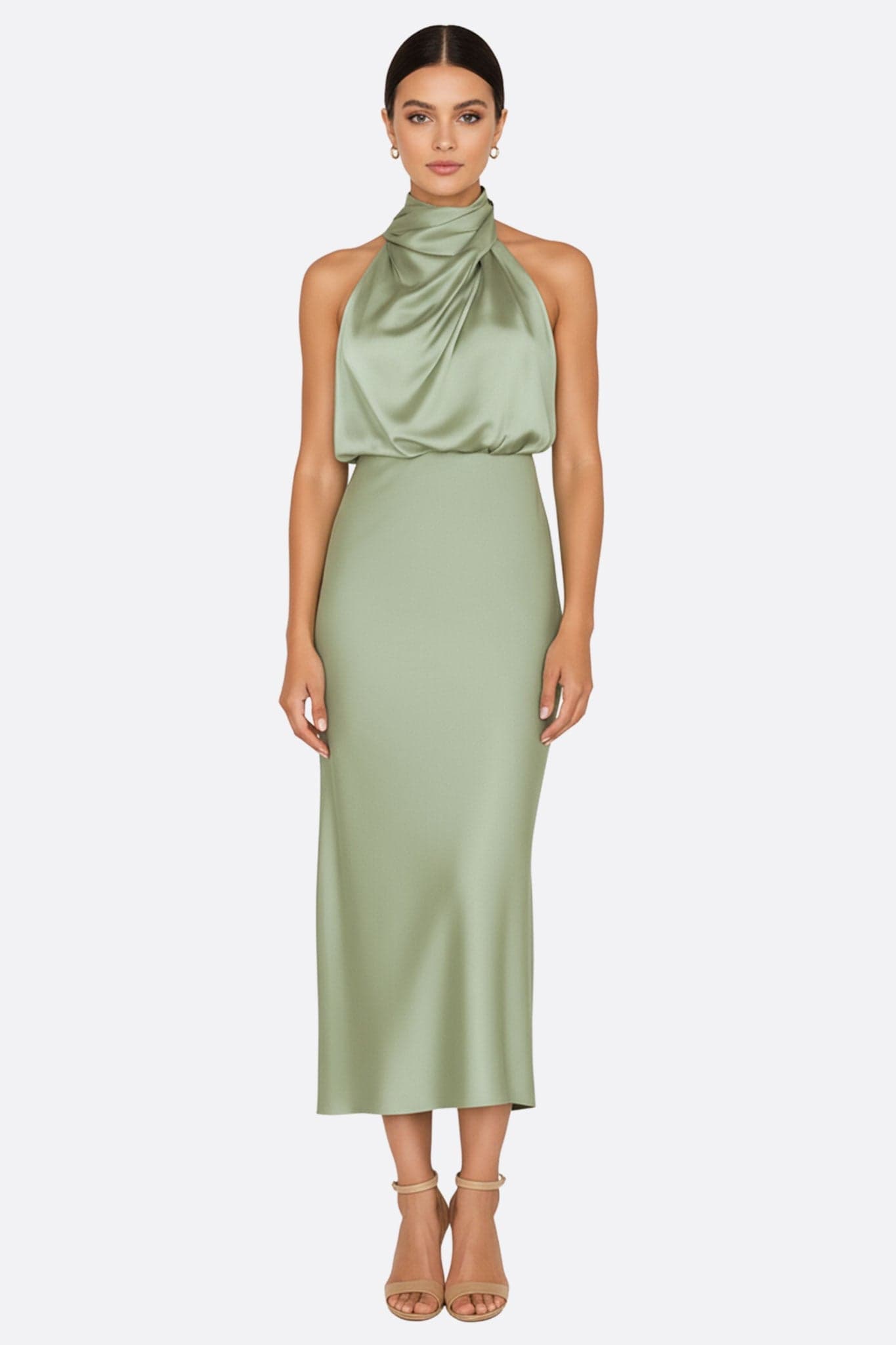
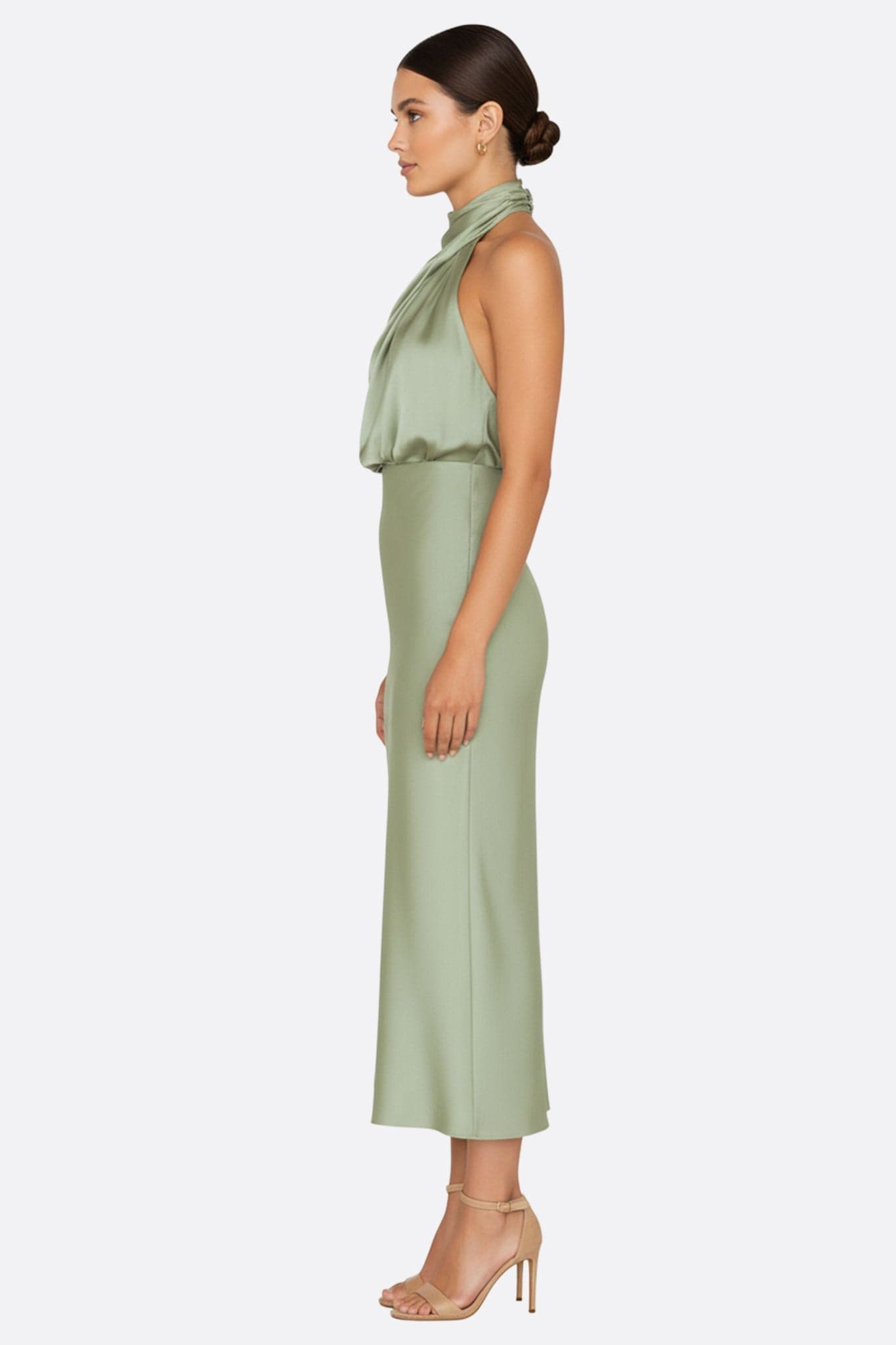
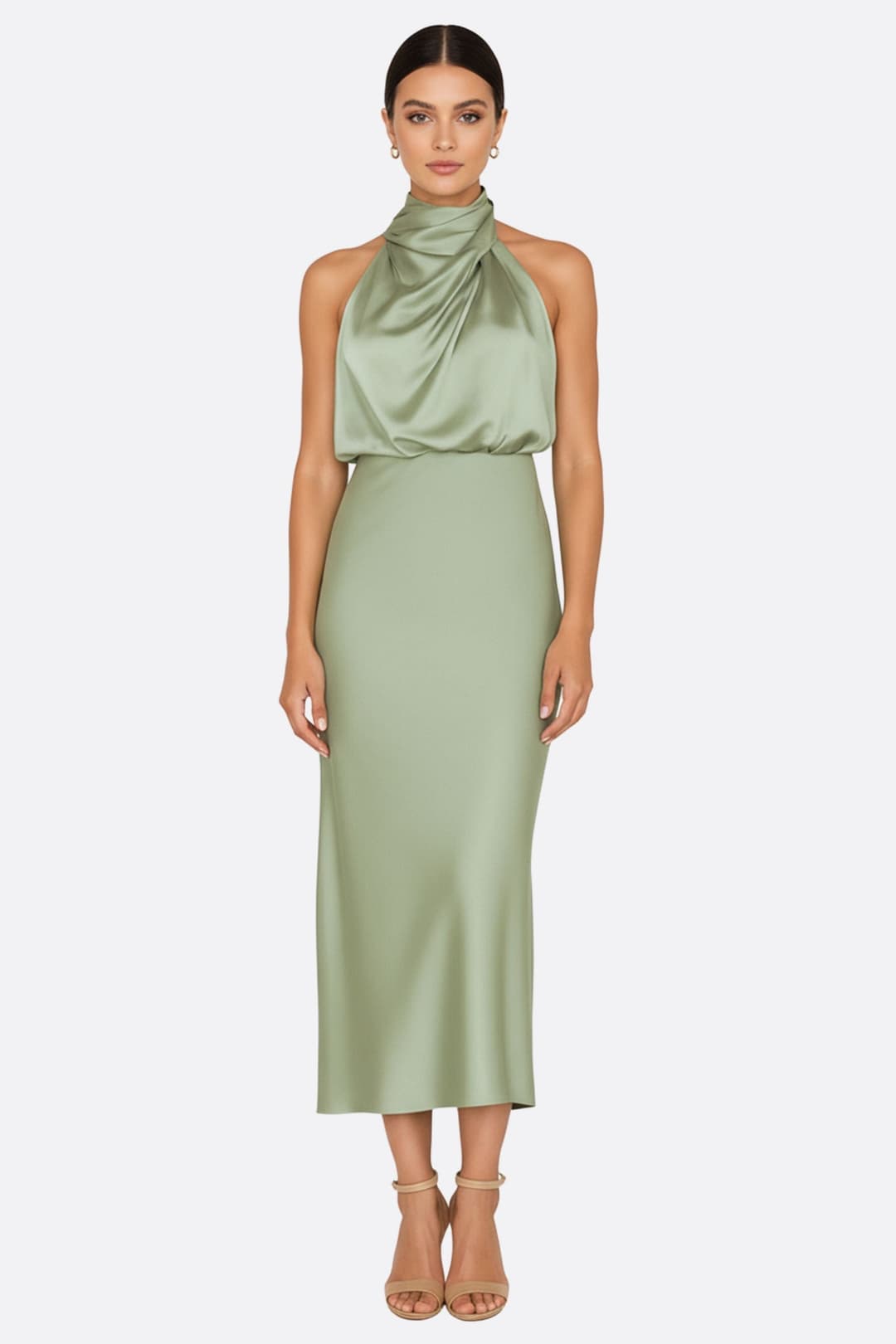
In practice: square shoulders call for a supple fabric on top, which breaks the angle, and a firmer fabric below. Present hips are smoothed with a matte crepe that falls straight, never with a shiny satin that catches the light. A straight silhouette gains presence with a structured fabric and a defined waist. The draped collar of our sage green satin midi dress, for example, lengthens the neckline and shifts the eye upward: it's the drape doing the work, not the cut.
Easy-care fabrics, and those that require a setting
"Easy to care for" doesn't mean indestructible: it means predictable. An easy fabric always gives the same result after washing. Knits (jersey, interlock, Milano knit) forgive the most: they wrinkle little and regain their shape on a hanger. Crepe, whether viscose or polyester, stays presentable at the end of the day thanks to its grain that masks creases. Cool wools and twills hold up through a day at the office.
At the other end, pure linen lives intensely: it creases at the fold as soon as you sit down. That's not a flaw, it's its character, and you need to accept it before buying. A linen blended with cotton or viscose keeps the freshness while softening creases. Silk and lightweight viscose require a gentle wash, cold, without strong spinning. Cashmere demands hand washing or a wool program, flat drying, and rest between wears.
The right habits for everything else boil down to one line: short cycles, 30 °C at most, moderate spin, a mesh bag for knits and fine fabrics, never a dryer for pieces containing elastane, and hanging on a hanger right out of the machine so the fabric's weight de-wrinkles it.
Sensitive skin: fabrics that don't itch
When skin reacts, it's not in your head. It's an equation between friction, heat, moisture, and residues trapped in the fiber. Three criteria matter: a smooth surface that doesn't catch, breathability that prevents maceration, and stability that limits micro-friction from a fabric that moves.
The fabrics that soothe best are silk and silk crepe, naturally hypo-absorbent, combed or mercerized cotton, cleaner than raw cotton, lyocell and modal, which glide without static electricity, and fine knits in merino or cashmere, whose fiber is too fine to prick. Carded wool, acrylic, and cheap jerseys are the first to irritate.
Often, it's not the fiber that itches but what the label doesn't say: an anti-wrinkle finish, a poorly rinsed dye, a thick seam at the neckline, the label itself. Wash a new piece before the first wear, press the fabric for thirty seconds against the side of your neck rather than your hand, and cut off labels that rub. These tips are general: persistent irritation should be shown to a dermatologist.
Recognizing a fabric that will last
Durability plays out in what a photo doesn't show: the twist of the yarn, the density of the weave, stability in washing, the quality of finishes. Four proofs can be obtained in sixty seconds in a store. The hand: slide the fabric between thumb and index finger, a durable material has a calm presence, neither pasty nor floaty. Density: against the light, a quality fabric lets through even light, without holes or lighter areas. Rubbing: ten seconds of palm against fabric, on a discreet area, and you'll know if it pills. The crease: press for three seconds, release, and see if the mark stays sharp.
"100%" doesn't mean durable. A short-staple cotton pills, a too-loose knitted wool felts, and a small percentage of elastane saves the fit of pants worn weekly. What matters is the coherence between the fabric and the intended use: an evening dress can accept the fragility of a chiffon, everyday pants cannot.
For silk, the gesture that extends a piece's life the most is simple: hand wash in cold water with a gentle detergent, dry flat in the shade, iron at a low temperature under a cotton cloth, and store on a padded hanger, never a metal one. Silk is not washed after every wear; it is aired out.
What the history of fabrics teaches those who buy today
Textile innovations do not replace older ones; they add to them. Linen, wool, silk, and cotton have never disappeared; viscose (1890s), then polyester (1940s) and elastane (1960s) came to correct their flaws or lower their cost. A modern label therefore almost always tells a compromise story, and reading that compromise is the real skill.
The vocabulary avoids misunderstandings: the fiber is the origin (cotton, silk, viscose), the yarn is its transformation, the weave is the way of weaving (plain, twill, satin), the knit is the knitted structure, and finishing encompasses dyeing, dressing, and final treatments. "Satin" is not a fiber but a weave: there is silk satin, viscose satin, polyester satin, and it is the fiber that determines warmth and care, while the weave determines the sheen.
Key takeaways
·The first fiber on the label dictates behavior; the lining dictates comfort.
·Weight, suppleness, elasticity, and surface matter more than the fiber's name for the drape.
·Knits and crepe are forgiving; pure linen and silk require accepting their character.
·Four tests in sixty seconds: the hand, the light, the rub, the crease.
·Satin is a weave, not a fiber: look for the fiber behind the shine.

Article by Alberto Alagna
Published on 13/01/2026 at 7:33 PM
About the author
Passionate about textile craftsmanship and sustainable design, Alberto Alagna brings to Misciano a vision where elegance meets ethics. With his experience in high-end ready-to-wear, he shares here his style tips and behind-the-scenes insights from the Maison Misciano.
→ Learn more about Alberto AlagnaFREQUENTLY ASKED QUESTIONS
Which fabrics should you prioritize for an elegant and durable outfit?
For an outfit that is both elegant and durable, opt for fabrics such as virgin wool, cashmere, or silk. Virgin wool offers excellent thermal insulation while remaining breathable. Cashmere, with its soft and lightweight texture, provides unmatched comfort, while noble silk ensures a flawless drape. These natural fibers are also more environmentally friendly, reinforcing the ethics of your wardrobe.
How can you recognize a quality fabric?
The quality of a fabric is measured by its density, texture, and finish. High-quality fabrics, such as silk satin or crepe, have a pleasant feel and a fluid drape. Inspect the finishes: well-executed seams and hemmed edges reflect exceptional craftsmanship. A good fabric should also withstand wear while retaining its luster, which is essential for a timeless piece from the Misciano collection.
What are the advantages of natural materials compared to synthetic ones?
Natural materials, such as cotton, wool, or silk, offer breathable and thermoregulating properties, ideal for everyday comfort. Unlike synthetic fabrics, which can sometimes be irritating, natural fibers are gentle on the skin and ensure better moisture wicking. Additionally, these materials are often biodegradable, making them a responsible choice for sustainable and environmentally friendly fashion.
How do I care for my delicate fabric garments?
To preserve the beauty and longevity of your delicate fabric garments, opt for hand washing with gentle products. Avoid direct sunlight during drying to prevent fading. Ironing at a low temperature is recommended on the reverse side of the fabric to avoid marks. By following these tips, you ensure the durability and radiance of your exclusive pieces from Maison Misciano Paris.
Which fabrics should I choose for a spring look?
For a spring look, turn to light and airy fabrics like linen or viscose. Linen, with its slightly textured feel, promotes optimal air circulation, perfect for warm days. Viscose, on the other hand, offers a fluid and elegant drape while being very comfortable to wear. These materials embody refinement and comfort, while allowing great freedom of movement, essential to Misciano's spring collection.