Maintenance of a women's jumpsuit: the protocol to keep a piece clean, fluid, and well-cut
A jumpsuit that fits well has one requirement: to stay neat without losing its shape. The problem arises quickly: a crease at the knee, a slight odor at the collar, fabric that shines from ironing, or a belt that warps after washing. The care of women's jumpsuits is not about "cleaning," but about preserving the fabric's feel, the seams' integrity, and the cut's precision.
Read the label and diagnose the material: the basis of error-free women's jumpsuit care
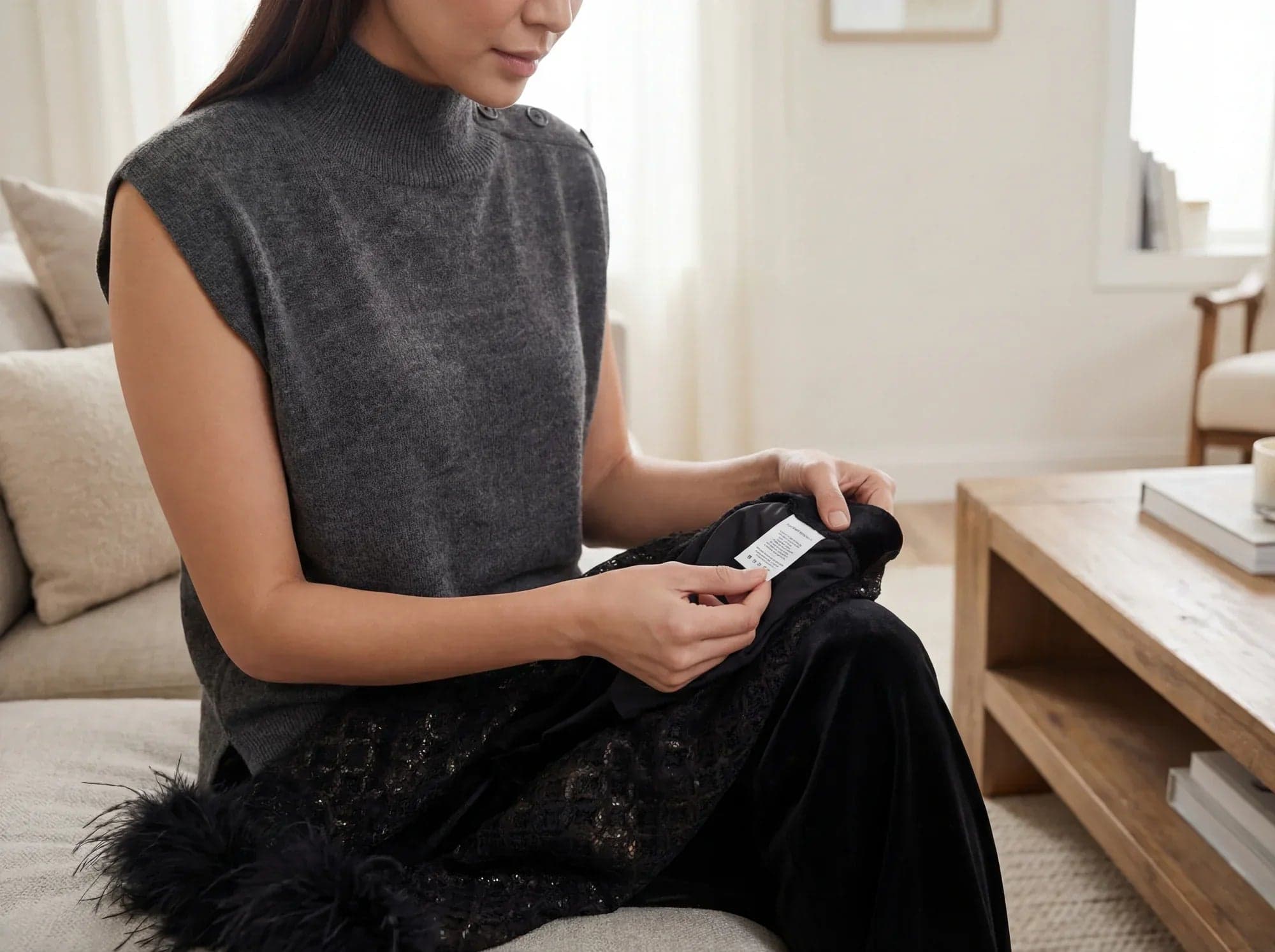
Before starting a machine or booking a dry cleaner, take thirty seconds: the label is not decorative, it mainly indicates what the fabric can withstand without losing its shape. In effective women's jumpsuit care, material diagnosis is the difference between a piece that remains fluid and one that "breaks."
Start by identifying three pieces of information:
- Maximum temperature (30 °C, 40 °C): beyond this, some fabrics shrink or deform, and linings wrinkle.
- Prohibition or permission of tumble drying: a hot drum can "cook" elastane, tighten a viscose, or create irreversible creases.
- Professional cleaning (P / F): this indicates that dry cleaning is recommended, often for structured, lined pieces, or those with delicate finishes.
Then, feel the fabric. The feel informs you: viscose gives a cool and slightly slippery sensation, but it is fragile when wet; crepe has a dry texture and holds well, but it can whiten if pressed with an iron; fluid polyester tolerates washing better, but can retain odors if too much detergent is used and rinsed poorly.
Check the risk areas: armpits, neckline, belt, hems. If you feel localized stiffness (deodorant, sweat), dry cleaning is not necessarily required: a gentle pre-treatment often suffices. However, if the jumpsuit is lined, has interfacings (plastron, collar, button placket) or details (flat pleats, very marked darts), steam and/or dry cleaning become allies to maintain the structure.
Finally, anticipate the use: if you often wear your jumpsuit during the day, opt for regular but light care (airing + steam). If it's an "event" piece, prefer more controlled cleaning (dry cleaning), especially if the color is deep (black, navy) and the fabric is sensitive to glossing.
Home washing: safe method (hand or machine) to avoid shrinkage, deformation, and marks
Washing is the step where the fit is most easily lost: an overfilled drum, too high a temperature, aggressive spinning, and the suit starts to pull at the seams or "twist" on the leg. For a consistent women's suit care, the goal is simple: clean without damaging the fiber, and without breaking the drape.
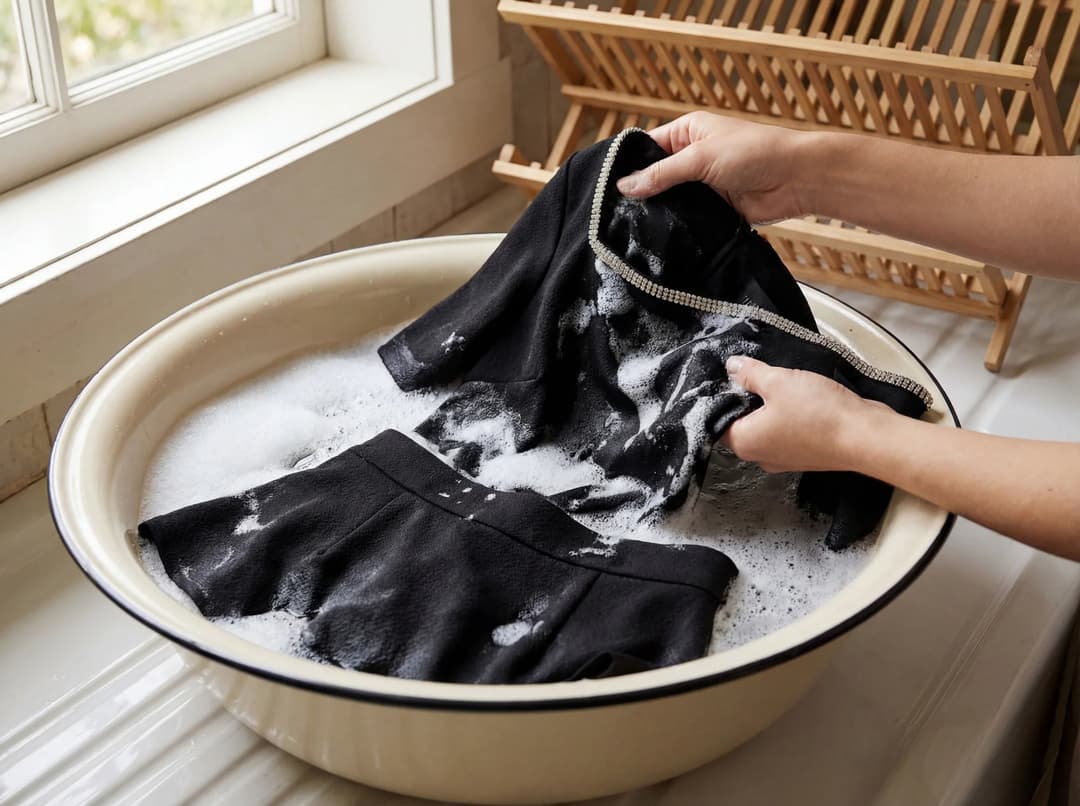
Rule #1: turn the suit inside out. This protects the surface (especially blacks and textured fabrics), limits friction on the seams, and reduces shine. Close zippers and buttons to stabilize the piece.
In the machine (if allowed):
- Program: delicate / wool, 20–30 °C. Lukewarm water is sufficient for most everyday dirt.
- Spin: 400 to 800 max. Too strong a spin marks the knees, crushes the folds, and tires the seams.
- Detergent: liquid, moderate dose. Too much detergent = incomplete rinsing = fabric that "stiffens" and retains odors.
- Mesh bag: recommended for fluid fabrics (viscose, fine crepe) and details (thin straps, removable belt).
By hand (ideal for viscose, silk, very fluid pieces):
- Fill a basin with cold to lukewarm water, add a small dose of mild detergent.
- Immerse, press gently: no twisting.
- Rinse until the water is clear, then press in a terry towel to remove excess water.
Pre-treat without damaging: for the underarms and collar, apply a drop of mild soap (like Marseille soap or delicate detergent) and massage very lightly. Avoid aggressive stain removers on dark fabrics: they can create a halo more visible than the initial stain.
Drying: the phase that sets the drape. Hang on a wide hanger (stable shoulder), realign the seams of the bodice, and align the legs. Let air dry, away from a radiator. To maintain a neat leg, you can pinch the side seam between your fingers and smooth it down: this simple gesture prevents "twisting" after drying.
Absolutely avoid: fabric softener (it clogs certain fibers and can dull elasticity), tumble dryer (unless explicitly mentioned), and too frequent washing. Between washes, airing and steaming are often sufficient: it's the logic of precise, not intensive, care.
Steam and ironing: smooth without glossing, restore shape, and respect structured areas
Steam is your most cost-effective tool: it refreshes, relaxes creases, and gives the fabric a sharp presence without mechanical aggression. In a women's jumpsuit care, it helps to space out washes and keep a clean silhouette, especially when the jumpsuit has only been worn for a few hours.
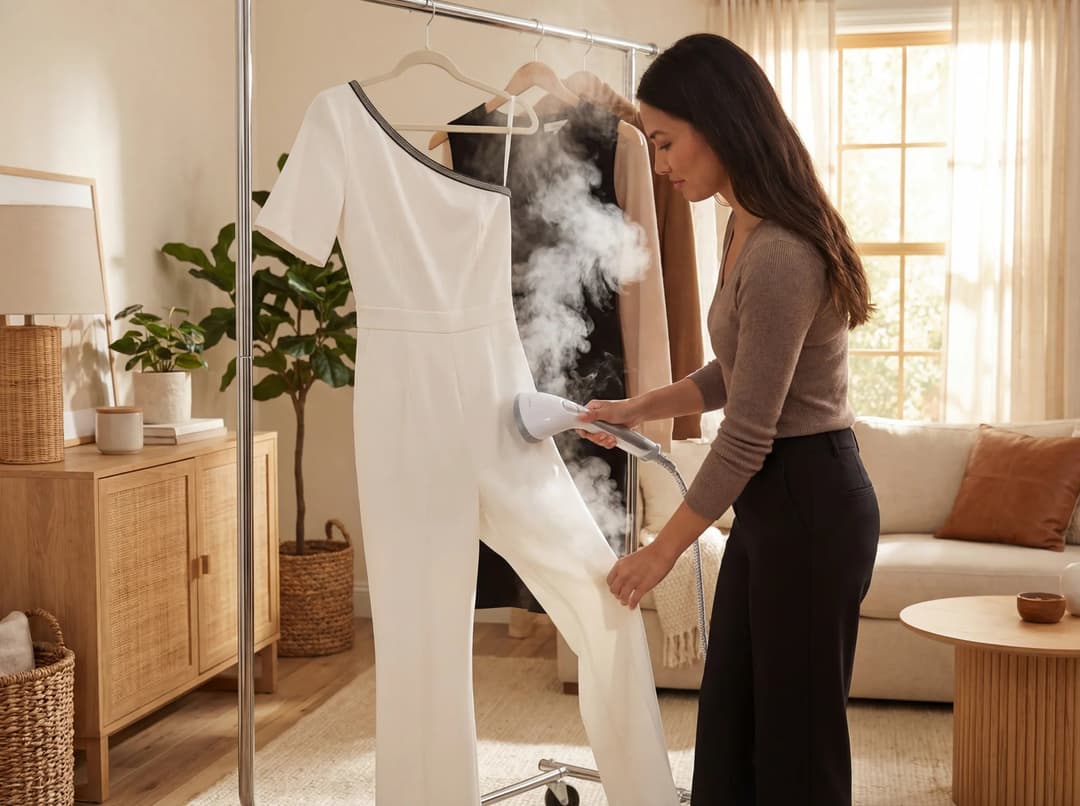
Vertical steam: the sure gesture. Hang the jumpsuit, slightly stretch the fabric with one hand (without pulling on the seams), and pass the steamer at 2–3 cm. The steam should "caress": the goal is to relax the fibers, not crush them. You will feel the material relax, the crease open, and the fabric regain a quieter fluidity to the touch.
Ironing: only if necessary. If you need to mark a leg crease or straighten a button placket:
- Use a damp cloth (fine cotton cloth) to avoid glazing, especially on black, navy, crepe, and synthetic fabrics.
- Set the temperature according to the label; if in doubt, start low and gradually increase.
- Do not "slide" too much: prefer to place/lift, to avoid stretching the bias and deforming the darts.
Sensitive areas:
- Knees: avoid crushing the area. Steam + reshaping by hand is often enough.
- Belt and waist: iron flat, without pulling. If the belt is interfaced, steam is preferable to direct ironing.
- Shoulders and armholes: use a small support (towel roll) to respect the volume.
Workshop tip: after steaming or ironing, let the jumpsuit cool on a hanger for 10 minutes. Cooling sets the shape. Putting it on immediately will "imprint" new creases in the wrong places.
For example, a black crepe jumpsuit tends to crease at the knee if the washing program is not followed, hence the importance of light pre-treatment followed by gentle steaming.
Dry cleaning: when to choose it, how to request it, and how to retrieve a flawless jumpsuit (without shine or odors)
Dry cleaning is not a mandatory step: it is a tool, to be used when the material, construction, or use requires it. In the care of a women's jumpsuit, dry cleaning becomes relevant in four cases: delicate fabric (silk, certain crepes), lined/interfaced piece, difficult greasy stain, or need for a very neat appearance (event, photo, meeting).
When to favor dry cleaning:
- Lining + interfacing: the structure can deform with home washing, especially if the spin is too strong.
- Deep colors: well-conducted dry cleaning limits fading and friction marks.
- Greasy stains (oil, makeup): professional treatment avoids the "fixed" halo from improper washing.
- Embedded odor: if the fiber has retained the odor despite airing, a suitable cleaning is more effective than overdosing detergent.
-

What to say at the dry cleaner's (yes, it changes everything):
- Indicate the areas to be treated: armpits, collar, localized stain. This avoids overly aggressive cleaning on the whole.
- Request a non-glossy ironing: "steam finish, gentle iron, damp cloth if necessary." This is particularly important on dark fabrics.
- If the jumpsuit has pleats to maintain, specify: leg pleat to reform or conversely "no marked pleat" if you want a natural drape.
Upon retrieval: quick checks. Under bright light, check:
- Shininess on thighs, buttocks, knees: sign of an iron that is too hot or too heavy.
- Persistent solvent smell: air on a hanger for 24 hours in a ventilated room. If the smell remains, return to the dry cleaner's.
- Darts and seams: they should remain sharp, without waviness. Waviness can come from steam that is too humid.
Recommended frequency: for a jumpsuit worn occasionally, one dry cleaning at the end of the season may suffice. For a frequently worn piece, alternate: airing + steam during wears, home washing when the label allows, occasional dry cleaning to "level up" the piece (structure, stains, appearance).
Storage after dry cleaning: remove the plastic (it retains moisture), hang on a wide hanger, and let it breathe. A fabric that breathes retains a more pleasant feel, less "stiff."
By applying this protocol, you keep the essentials: a jumpsuit that remains neat to the eye, pleasant to the touch, and true to its cut. Good maintenance does not add constraints; it establishes a precise routine, serving the drape.
Warning: Always test these tips on a hidden area of your garment before any application. In case of doubt, consult a professional.
To go further:
- To choose a jumpsuit from the start with materials that facilitate maintenance, how to choose a quality women's jumpsuit that will last
- To not compromise the quality of your piece by a wrong move, Mistakes to avoid with a women's outfit: 12 missteps that ruin the silhouette
- To know the specific maintenance constraints for each material, the Misciano Material Observatory

Article by Esther Arnaud
Published on 08/02/2026 at 07:34
About the author
What interests me above all is not the immediate trend, but the coherence of a wardrobe. I like to analyze why a piece works, how a material influences movement, and how a garment can accompany a woman over time, without ever imposing itself.
→ Learn more about Esther ArnaudFREQUENTLY ASKED QUESTIONS
How do I know if my jumpsuit is suitable for machine washing?
The first step is to check the care label. It indicates the fabric specifics and the recommended washing conditions. A delicate fabric like silk or wool often requires hand washing or dry cleaning to preserve its texture and shape. Do not neglect this step to avoid damage.
What should I do if my jumpsuit has wrinkles after washing?
Marked wrinkles can be caused by improper washing or drying. To remedy this, opt for low-temperature ironing, using a protective cloth to avoid direct contact with the iron. This will help restore a neat shape to your garment while preserving its fabric.
How to preserve the color and texture of my jumpsuit after several washes?
To maintain the brightness of colors and the softness of textures, it is advisable to use mild detergents suitable for delicate fabrics. Avoid exposing your jumpsuit to direct sunlight drying, which could alter the colors. By opting for a cold water wash, you will contribute to the longevity of your garment.
Why is it important to use a dry cleaner for certain jumpsuits?
Dry cleaning is recommended for delicate fabrics or garments with special finishes. Dry cleaning professionals have the appropriate techniques to treat noble materials without risk of deformation or deterioration. This ensures a flawless fit of your jumpsuit, preserving its silhouette and texture.
How to prevent my belt from warping after washing?
To prevent the belt from warping, make sure to remove it before washing. Wash your jumpsuit inside out and use a gentle cycle. Flat drying is also recommended to avoid any tension on the seams. This will help maintain the shape of the belt and the integrity of the garment.
Shop the selection