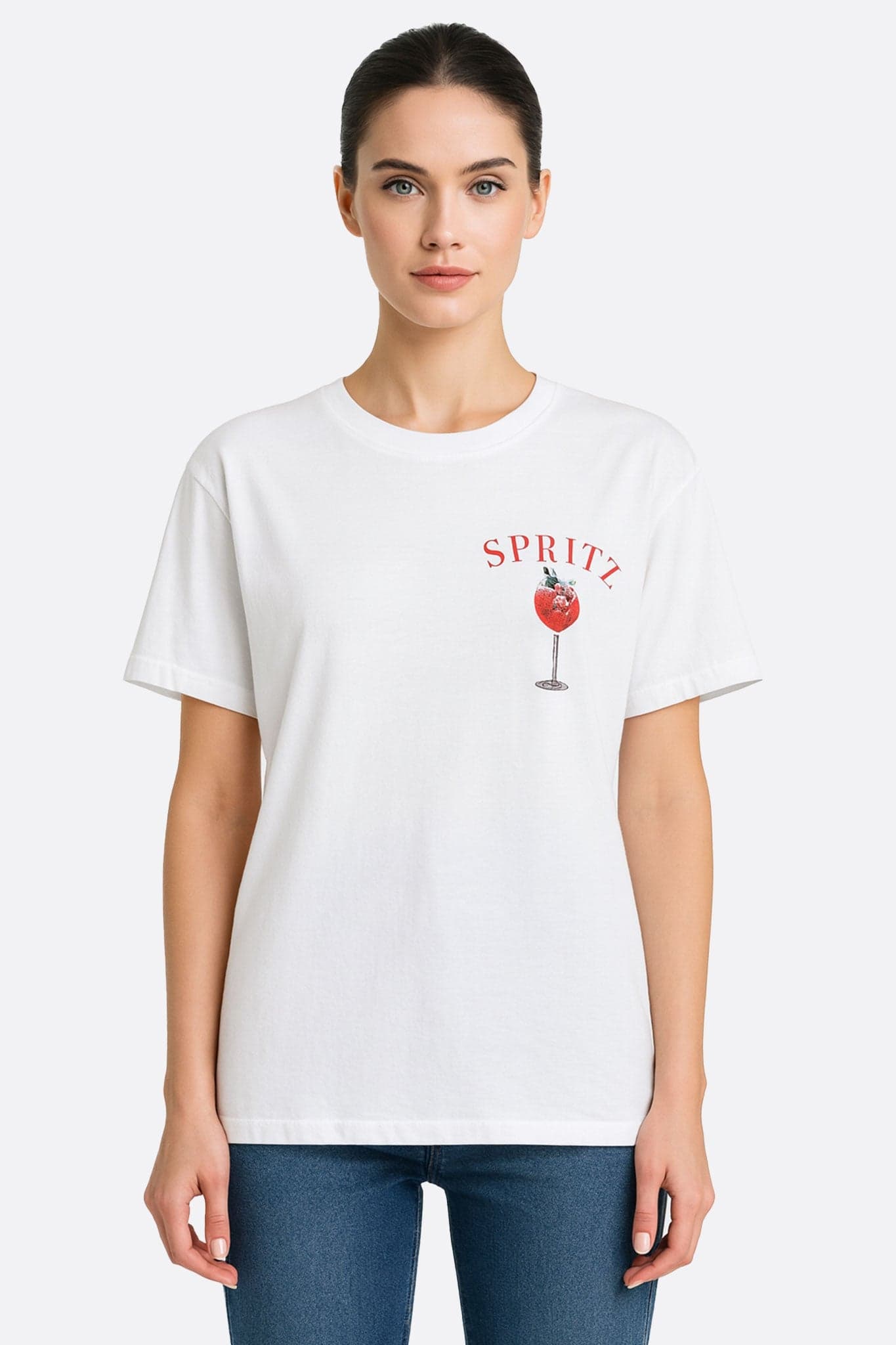
The art of choosing: the quality women's t-shirt and its durable cut

The t-shirt is the most worn piece in the women's wardrobe and yet one of the most poorly chosen. Between models that shrink after the first wash, collars that deform, and materials that pill, the difference between an ordinary t-shirt and a quality t-shirt is evident in years of wear. This guide covers the objective criteria for making the right choice: weight, cut, material, collar, and care.
Cotton weight: the number one criterion that no one considers
Weight is expressed in grams per square meter (g/m²) and directly determines the fit and opacity of a t-shirt. A quality organic cotton t-shirt ranges between 160 and 200 g/m².
| Weight | Appearance | Recommended use |
|---|---|---|
| Less than 120 g/m² | Transparent, visible on the back | Layering only |
| 120–150 g/m² | Semi-transparent | With underwear or doublet |
| 150–180 g/m² | Sufficiently opaque | Everyday, casual office |
| 180–220 g/m² | Fully opaque, good fit | Wear alone with confidence |
Simple store test: slide your hand inside the t-shirt and see if your fingers are visible through it. If so, the weight is insufficient for wearing without layering.

Women's white t-shirt in organic cotton: opacity and drape directly linked to weight.
Organic cotton t-shirt or conventional cotton: what really changes
Organic cotton is grown without synthetic pesticides or GMOs. In practice, for a t-shirt, the difference is evident in three areas:
- Softness to the touch: organic fibers are less chemically treated, preserving their natural structure. A GOTS-certified organic cotton t-shirt remains soft wash after wash.
- Dimensional stability: a well-cut organic cotton t-shirt shrinks less, provided you respect the 30°C washing temperature.
- Color treatment: dyes used in organic spinning are less aggressive. White stays white longer, without yellowing.
Linen is an interesting alternative for summer: more breathable than cotton, it dries faster and becomes more supple with each wash. Its downside: it wrinkles easily.
Cotton jersey (knitted fabric) is the most common construction for t-shirts. Check that the jersey is "single jersey" (single layer) or "interlock" (double layer, thicker and more stable).
Round neck or V-neck: which to choose according to your body shape
The collar directly influences the perception of the bust and neck. There is no universally flattering collar: the choice depends on the body shape.
Round neck: versatile, it suits all body shapes. It elongates the bust on H-shaped bodies (rectangular silhouette). Avoid if the neck is very short, as it visually shortens it.
V-neck: creates a vertical line that optically stretches the bust. Ideal for O or X body shapes to visually lighten the top. A neckline too deep (below the chest) becomes difficult to wear at the office.
Boat neck: horizontalizes the gaze, enhances narrow shoulders. Not recommended for V-shaped bodies (broad shoulders) as it accentuates the width.
Peter Pan collar (with broken collar) or band collar (small stand-up collar): adds a detailed touch, easily worn with a structured jacket for an office ensemble.

Pink fitted t-shirt: the natural drape reveals the quality of the knit.
Fitted, straight, or oversized cut: how to choose according to use
The cut defines the relationship between the garment and the body. It is chosen based on the main use and the desired silhouette.
Fitted cut: follows the shapes without tightening. It works under a blazer jacket, with high-waisted pants or a structured skirt. Point of attention: the shoulder seams must fall exactly on the shoulder bone, not set back.
Straight cut: slightly looser than the body, without excess fabric. It is the most versatile: can be worn tucked into pants, tied, or flowing. The ideal length stops at mid-hip.
Oversized cut: loose by design, with dropped armholes. It is worn with a fitted bottom (slim, leggings, straight skirt) to avoid the bag effect. The length can be asymmetrical or stop at mid-thigh.
For a women's t-shirt worn at the office, favor the fitted or straight cut in non-transparent cotton (160+ g/m²), tucked into a high-waisted crepe pants or under a structured jacket.
How to read the finishes to assess quality
The finishes reveal the true quality of a t-shirt, beyond the weight and composition. Points to inspect:
- The side seams: a flat seam (hidden seam inside) holds better than a visible topstitch. Check that it does not ripple.
- The composition label: it must indicate the exact percentage of each material and the country of manufacture. A vague label ("natural materials") without precise percentage is a bad sign.
- The collar band: an inner sewn band (banded collar) stabilizes the collar and prevents it from rolling. Low-end t-shirts do not have it.
- The recovery elasticity: stretch the fabric at the shoulder and release. If the fabric immediately returns to its shape, the knit is of good quality. If it remains deformed, the t-shirt will quickly deform with wear.

T-shirt with detailed pocket: the edge finish and the quality of the stitching distinguish durable pieces.
Wearing a women's t-shirt at the office: what works
A t-shirt can be worn at the office provided that a few outfit construction rules are respected:
With high-waisted pants: tuck the t-shirt into wide high-waisted pants or cigarette pants. The contrast between the simple top and the structured bottom balances the outfit.
Under a jacket: a round-neck t-shirt in compact cotton (180+ g/m²) under a wool blazer jacket is one of the most solid combinations for the office. The jacket provides structure, the t-shirt brings comfort.
With a skirt: the t-shirt tucked into a structured midi skirt or a pencil skirt works for a casual office. Choose a thin belt to mark the waist if the bottom is loose.
What does not work at the office: a thin transparent cotton t-shirt, an oversized cut without bottom structuring, or a playful printed t-shirt without a jacket to "dress up".
How to care for a cotton t-shirt to make it last
Care is the most underestimated variable in the lifespan of a t-shirt. A quality organic cotton t-shirt, poorly maintained, will not survive two seasons.
Washing: 30°C maximum, delicate cycle. Cotton shrinks mainly during the first wash if the temperature is high. Wash inside out to preserve colors.
Drying: lay flat or hang from the shoulders, never from the collar tips. The dryer is not recommended for organic cotton: it degrades the fibers and exacerbates shrinkage.
Ironing: if necessary, iron inside out on the cotton setting (150°C). Steam is gentler than dry iron.
Storage: folded flat, not hung on a hanger (the hanger deforms the jersey shoulders). For storage, avoid drawers that are too tight which crush the knit.
Combinations and complements to dress up a t-shirt
The t-shirt is a neutral base that is styled according to the surrounding pieces.
With a silk or cashmere scarf: tied loosely around the neck or slipped into an open collar, it instantly elevates the outfit. A 90x90 silk square on a white t-shirt is one of the most effective combinations.
With jewelry and accessories: the wide round neck clears the neck and highlights long necklaces or pendants. A V-neck rather calls for a delicate pendant in the neckline.
With a cardigan or vest: the t-shirt under an open cardigan is the simplest layering to go from casual to semi-dressed. Choose a neutral-colored cardigan if the t-shirt is colored, and vice versa.
The white t-shirt tucked into a spring skirt is the base of "casual chic". The t-shirt provides neutrality that allows the bottom piece to fully express itself.

Article by Maryna Svistunova
Published on 03/18/2026 at 15:58
About the author
I am the editorial director of Misciano Paris. I define the editorial line with the conviction that fashion must be timeless, with rigor, coherence, and sincerity.
→ Learn more about Maryna SvistunovaFREQUENTLY ASKED QUESTIONS
How can I identify the quality of a women's T-shirt?
To recognize a quality T-shirt, examine the fabric used, its density, and softness. A good T-shirt is generally made from noble materials like organic cotton or silk. Also check the finishes: neat seams and a well-finished hem are indicators of durability.
What is meant by 'sustainable cut' for a T-shirt?
A sustainable cut refers to a timeless design that does not go out of style quickly. It should fit the body's shape without being too tight, offering both comfort and elegance. A good T-shirt retains its silhouette and appearance, even after several washes.
Why is the material of a T-shirt so important?
The material of a T-shirt not only influences how it feels on the skin but also its durability over time. Natural fabrics like cotton or silk breathe better and offer superior comfort. They are also often more environmentally friendly, which is essential for sustainable fashion.
What details should I look for in a sustainable women's T-shirt?
Pay attention to details such as the quality of the seams, the edge finishing, and the type of collar. A well-designed T-shirt features strong seams, a harmonious cut, and elements that enhance the design, ensuring a durable and refined aesthetic.
How to care for a quality T-shirt to extend its lifespan?
To preserve the quality of a T-shirt, opt for cold washing and air drying. Avoid hot washing which can damage the fibers and distort the fit. By following these care tips, you will ensure your T-shirt has appreciable longevity while maintaining its appearance.
Shop the selection