9 traps to avoid when buying a women's swimsuit
You've surely experienced it: a swimsuit that looks great on the hanger, but once wet, it slips, marks, sags, or "cuts" where you wanted a clean line. Most disappointments don't come from a lack of style, but from very specific women's swimsuit buying mistakes: misreading materials, choosing a size like a city garment, underestimating support, or ignoring lining. Here are 9 concrete traps to avoid, with textile markers and fitting gestures that change everything.
Relying on your usual size
How to avoid the trap:
- Dry fitting test: put on the swimsuit, then raise your arms, twist your torso, sit down. If the crotch already pulls or the top rides up, the size is too small (or the cut too short for your torso).
- Tension test: pinch the material at the hip and pull slightly: it should resist and return quickly, without a "chewing gum" impression.
- Simple marker: a swimsuit that seems barely too tight when dry is often perfect once wet, provided the seams don't mark aggressively.
If you're hesitating between two sizes, decide based on the expected support: for active swimming/sunning, prioritize fit; for very relaxed use, you can tolerate a bit more flexibility - but never to the point of slipping.
Choosing a "soft" material without checking chlorine/salt resistance
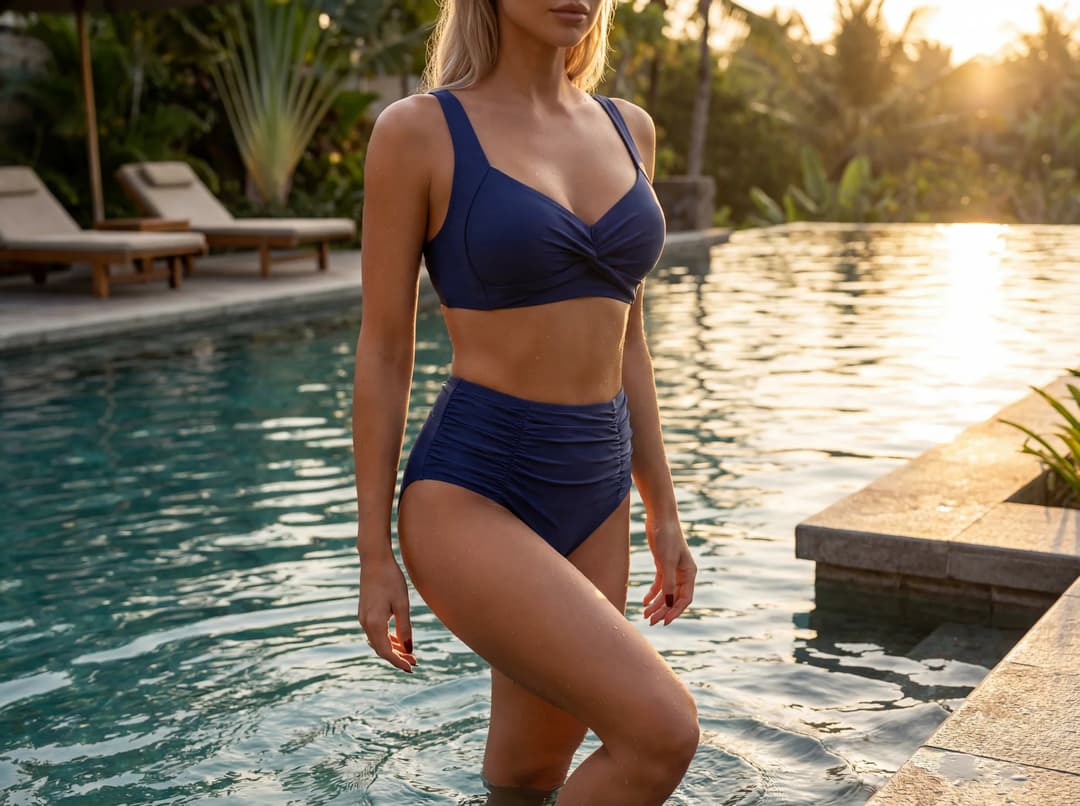
Second mistake in buying women's swimsuits: confusing pleasant feel with performance. A material can be delightfully smooth, almost silky to the touch, yet wear out quickly: loss of elasticity, whitening, pilling, or edges that ripple. The swimsuit experiences double stress: water (chlorine, salt) and mechanics (stretching, rubbing, towel wringing, sunscreen).
Signals to watch for: a fabric that is too thin, very shiny, and stretches easily between the fingers may indicate a more fragile hold if not properly stabilized. Conversely, a slightly denser fabric with a more "defined" texture often provides better support and ages more cleanly.
What you can ask/look for:
- Chlorine resistance (ideal if swimming pool): some compositions and finishes are designed to limit fiber breakage and relaxation. For example, opt for a swimsuit using PBT polyester for better resistance in the pool.
- Opacity: stretch the material over your hand. If the color "opens" and fades significantly, expect increased transparency when wet.
- Rebound: release after stretching. The return should be firm, without slowness.
- Recommended composition: for a good compromise between comfort and support, look for swimsuits made of polyamide/elastane. These materials offer durable hold and good resistance to chlorine and salt aggressions.
Misciano's advice: prioritize a feeling of support rather than immediate softness. The feel can soften over time, but a material that loosens does not "bounce back."
Neglecting the lining
Among the most costly mistakes in buying women's swimsuits: forgetting to check the lining. It often determines opacity, comfort against the skin, and how the swimsuit "sits" on the body. Without lining (or with too light a lining), the main material can stick, highlight contours, and become more revealing when wet.
What a good lining changes: it stabilizes the fabric, smooths the appearance, and limits the "stripes" effect caused by water. To the touch, you feel a second skin that is more matte, drier, avoiding the impression of fabric that grips. Visually, the line is sharper, especially around the lower abdomen and hips.
Fitting room checkpoints:
- Look against the light: if you immediately see your hand through it, the opacity may be insufficient when wet.
- Feel the lining: it should be soft but not "flimsy." A lining that is too stretchy does not provide structure.
- Check the edges: a poorly finished lining can create an extra thickness that marks or rolls.
Remember: if you want a sharp look in photos, a well-thought-out lining is your best ally. It's a discreet detail, but it's what makes the difference between a "pretty" swimsuit and one that remains impeccable in motion.
Underestimating bust support: straps, back, and internal architecture
Many women's swimsuit purchase errors come from a misconception: "if it holds dry, it will hold in water." However, water weighs down the material, sometimes reduces adhesion, and amplifies every micro-imbalance. Support does not only depend on cup size: it depends on the complete architecture - straps, back, band width, internal reinforcements.

The classic pitfalls:
- Straps too thin: they cut, slip, and end up making you adjust all day.
- Back too open: very pretty, but less anchorage. If you move, you lose stability.
- Lack of structure: without internal elastics or thoughtful construction, the chest "floats" slightly once wet.
Quick test: lean forward as if to pick up a towel. If you feel a risk of overflow or fabric detachment, the support is insufficient for your use.
Concrete advice: if you want to swim, play, walk for a long time, prioritize: adjustable straps, more closed back, stable under-bust band, and a material that does not easily stretch. To go further on selection criteria (without multiplying unnecessary trials), you can rely on the reference guide: Women's swimsuit: complete guide to make the right choice.
Forgetting torso height and length (especially in one-piece)
A very common and rarely anticipated women's swimsuit purchase error: torso length. Two women of the same size can have a longer or shorter torso, and a one-piece reacts immediately: it pulls on the shoulders, digs into the crotch, or conversely, gapes at the waist and back.
What you feel when it's not the right length: a vertical tension that tires, straps that "cut" despite a good chest circumference, or the impression that the swimsuit is trying to ride up. Conversely, if it's too long, the material wrinkles at the belly, water lodges there, and the line loses sharpness.
How to check in 30 seconds:
- Shoulder test: if you feel continuous pulling at the top, it's not a simple adjustment: it's often a length problem.
- Seat test: sit down. If the crotch becomes uncomfortable, the cut is too short for your torso.
- Back test: if the back gapes at the top while the bottom is tight, the length distribution does not suit you.
Tip: if you are between two sizes and your torso is long, going up a size can solve the pulling - provided that the chest and hips remain stable thanks to a shaping material and/or a structuring lining.
Choosing the wrong cut and discovering the "cut leg" effect or discomfort
Among the mistakes in buying women's swimsuits, the cutout is the one that most quickly transforms a beautiful model into a piece that one no longer dares to wear. Too low: it visually compresses, can create a horizontal line that "cuts" the leg, and limits ease. Too high: it can ride up when walking, increase friction at the groin, and require constant adjustments.
The key point: the cutout must follow your mobility. A good bottom stays in place when you take three steps, then when you sit down. If you feel the fabric moving and trying to settle into a fold, you will have this problem all day - and even more once wet.
Fitting benchmarks:
- Walk: 10 steps are enough. If it rides up, it's not "you," it's the cut (or the size).
- Climb a step (or simulate): if the elastic pinches, the cutout is too aggressive or the thigh opening too tight.
- Check the edge: an elastic that's too hard marks, an elastic that's too soft slips. The right elastic holds without leaving a clear mark.
Objective: a clean line that elongates without constraining. The sensation should be stable, almost "silent": you no longer think about it.

Buying a color/print without anticipating the wet effect and durability
Another mistake in buying women's swimsuits: choosing a color solely based on store lighting. A shade can be sublime when dry and transform when wet: darkening, lighter areas on stretched parts, or contrast that highlights folds you didn't see. Prints, on the other hand, can visually distort if the fabric is too stretchy or if the cut pulls in certain areas.
What matters: visual stability. A deep color must remain dense when the material is under tension. A print must remain legible without "opening" at the hips or chest.
Simple tests:
- Stretch the material: if the print "breaks" and whitens, the wet effect will be more contrasted.
- Look at the tension areas (side seams, cup, pelvis): if the color is already fading, it will fade more once wet.
- Prefer shades and patterns that maintain a clear reading even under tension: it's an indicator of print quality and fabric density.
A well-chosen color gives a clear, almost velvety look. A poorly chosen color forces you to "monitor" your swimsuit - which is never the goal.
Ignoring seams and finishes: where everything is played out when worn
If you want to avoid women's swimsuit purchase mistakes, look at the finishes like an expert: they determine comfort on wet skin. A poorly placed or too thick seam becomes a friction point. A poorly elasticated edge warps. A too rigid assembly breaks the line instead of accompanying it.
What good finishing gives: a feeling of a "clean" edge, without aggressive over-thickness. Visually, the seam follows the body without undulating. To the touch, you feel continuity, not an edge.
Checklist in the fitting room:
- Lightly rub the edge against the skin (hip, underarm): if it irritates dry, it will be worse wet.
- Inspect the stitches: they must be regular, without loose areas.
- Identify strategic seams: at the crotch and sides, they must be neat and comfortable, as they undergo the most tension.
Misciano's advice: favor finishes that "disappear" when worn. A successful swimsuit is not marked by its seams, but by its continuous line and stable comfort.
Not adapting the choice to actual use
Last trap - and often the most decisive - in women's swimsuit purchase mistakes: buying for an image, rather than for your dominant use. A swimsuit designed for tanning (less structure, more open cuts) does not have the same requirements as a swimsuit for swimming (fit, stability, resistance) or for spa (comfort, softness, non-irritating finishes).

Clarify your main scenario:
- Tanning: favor edges that do not mark too much, a pleasant material on warm skin, and a cut that remains pretty even when lying down.
- Swimming/activity: look for support, a denser material, reliable straps, an anchored back, and a stable cut.
- Walking/active beach: avoid what rides up, what slips, and what requires adjustments. Stability is key.
- Spa: focus on softness and comfortable finishes, but without sacrificing opacity.
The gesture that avoids 80% of mistakes: make three movements in the fitting room (arms in the air, bending, sitting) and ask yourself: "can I forget this swimsuit for two hours?" If the answer is no, it's not the right one, even if it looks very beautiful when still.
In summary: the best decisions come from a balance between material, structure, and use. A well-chosen swimsuit is recognized by its calm fit: it does not move, does not mark unnecessarily, and maintains a neat line from the first swim to the last.
Care and usage tips
To ensure the durability of your swimsuit, a few simple care gestures are essential:
- Rinsing: rinse the swimsuit thoroughly with clear water after each use to remove chlorine, salt, and sunscreen residues.
- Wringing: avoid vigorous wringing or mechanical twisting, which could fatigue the fibers.
- Drying: favor drying in the shade to preserve the brightness of the colors and avoid premature aging of the materials.
- Additional recommendations: consult the specific care guides for the fibers used (for example, recommendations for PBT polyester or polyamide/elastane) and look for indications on the label about the weight and quality of the finishes.
These tips, validated by external sources and recognized industry standards, enhance the reliability and durability of your purchases.
For a complete guide on choosing your swimsuit, consult Women's swimsuit: complete guide to make the right choice.
Discover our swimsuit collection (starting from 40€).
To go further, check out our accessories.
For a complete guide on choosing your swimsuit, consult Women's swimsuit: complete guide to make the right choice.
Discover our swimsuit collection (starting from 40€).
To go further, check out our accessories.

Article by Alexander Chekushine
Published on 04/01/2026 at 10:42
About the author
A specialist in style and fashion trends, I bring a sharp eye to Misciano's creations. My in-depth knowledge of noble materials and Italian craftsmanship enriches each of my articles with a precise and demanding reading of contemporary elegance.
→ Learn more about Alexander ChekushineFREQUENTLY ASKED QUESTIONS
Why shouldn't I buy a swimsuit based solely on my usual size?
Swimsuits have specific elasticity that differs from city clothes. It is essential to try the swimsuit to assess its fit, as a usual size may not account for the actual elasticity of the fabric. This can lead to inappropriate comfort and discomfort when worn.
What materials should I prioritize for a quality swimsuit?
Opt for noble materials like polyamide or elastane, which offer both comfort and support. These fabrics are designed to withstand water while maintaining their shape and elasticity, ensuring an elegant silhouette even after several swims.
How can I ensure that my swimsuit's support is sufficient?
To evaluate the support, wear the swimsuit and perform some movements. Check that the fabric supports well without being too tight. A good indication is that the swimsuit should stay in place without slipping, while allowing comfortable freedom of movement.
Why is it important to pay attention to the lining of a swimsuit?
The lining of a swimsuit can influence its comfort and durability. A quality lining contributes to better support, prevents unwanted marks on the skin, and ensures sufficient opacity, especially when wet. Do not neglect it in your choice.
What fitting actions should I adopt to choose the right swimsuit?
During the fitting, adopt a standing position and perform movements like sitting or raising your arms. This will allow you to check the fit of the swimsuit in all situations. Do not hesitate to move to ensure it does not slip and respects your desired silhouette.