Silk square: 9 common mistakes that damage the fabric without us realizing it

You tied your scarf in a hurry, and suddenly everything “falls apart”: the fold starts to ripple, the knot thickens, the silk loses its shine, and the whole looks less neat. Most of the time, it's not the scarf that's at fault, but a series of tiny gestures, too tight, too hot, too perfumed, too rubbed, which end up breaking the look and tiring the fiber. A silk scarf does not forgive approximation: it immediately reveals the hand, the tension, the intention.
Below, I scrutinize 9 mistakes with a silk scarf that I see recurring constantly, with concrete corrections. The goal is not to add rules: it's to achieve a clean drape, a proper shine, and a material that retains its hand, season after season.
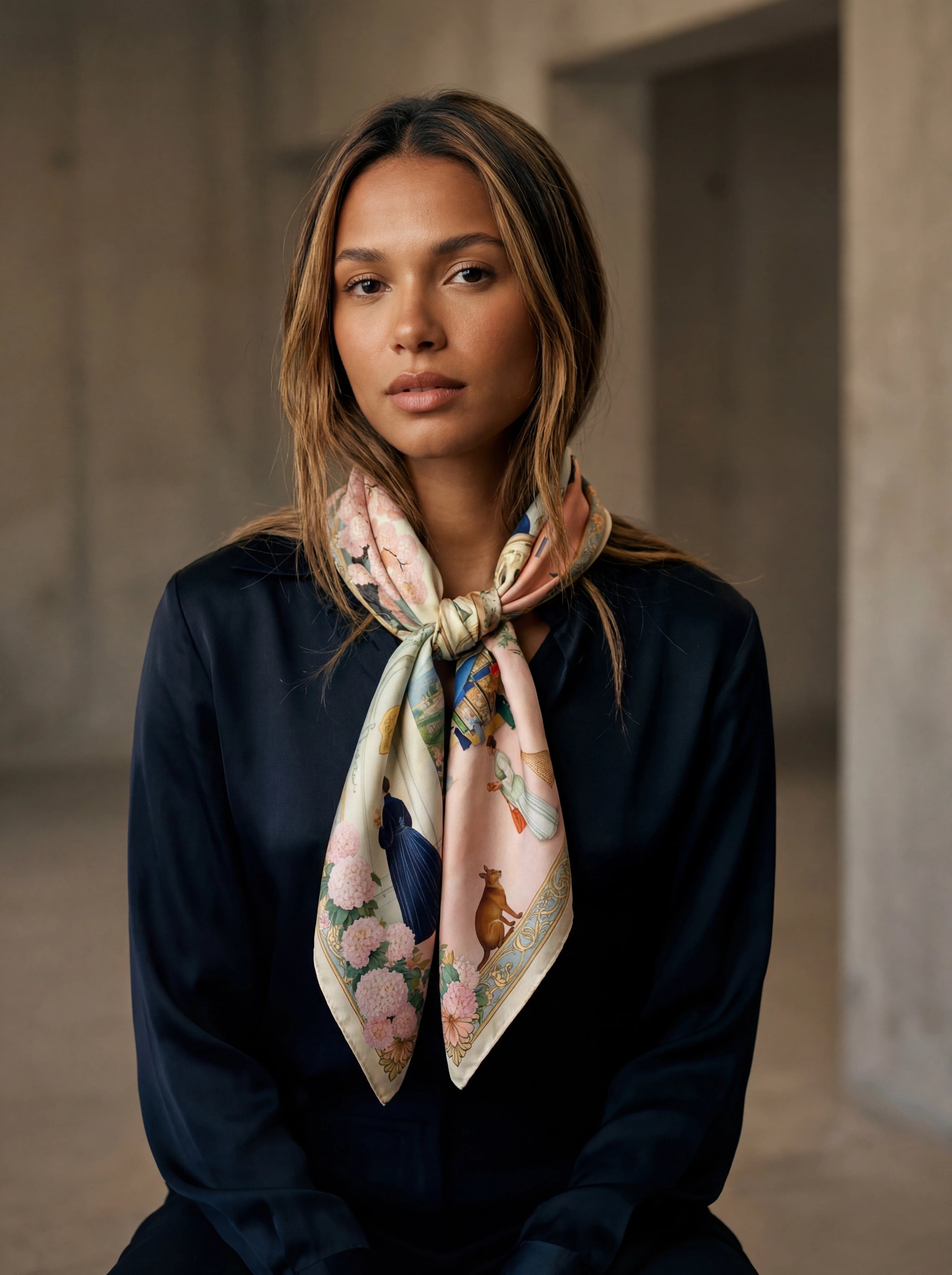
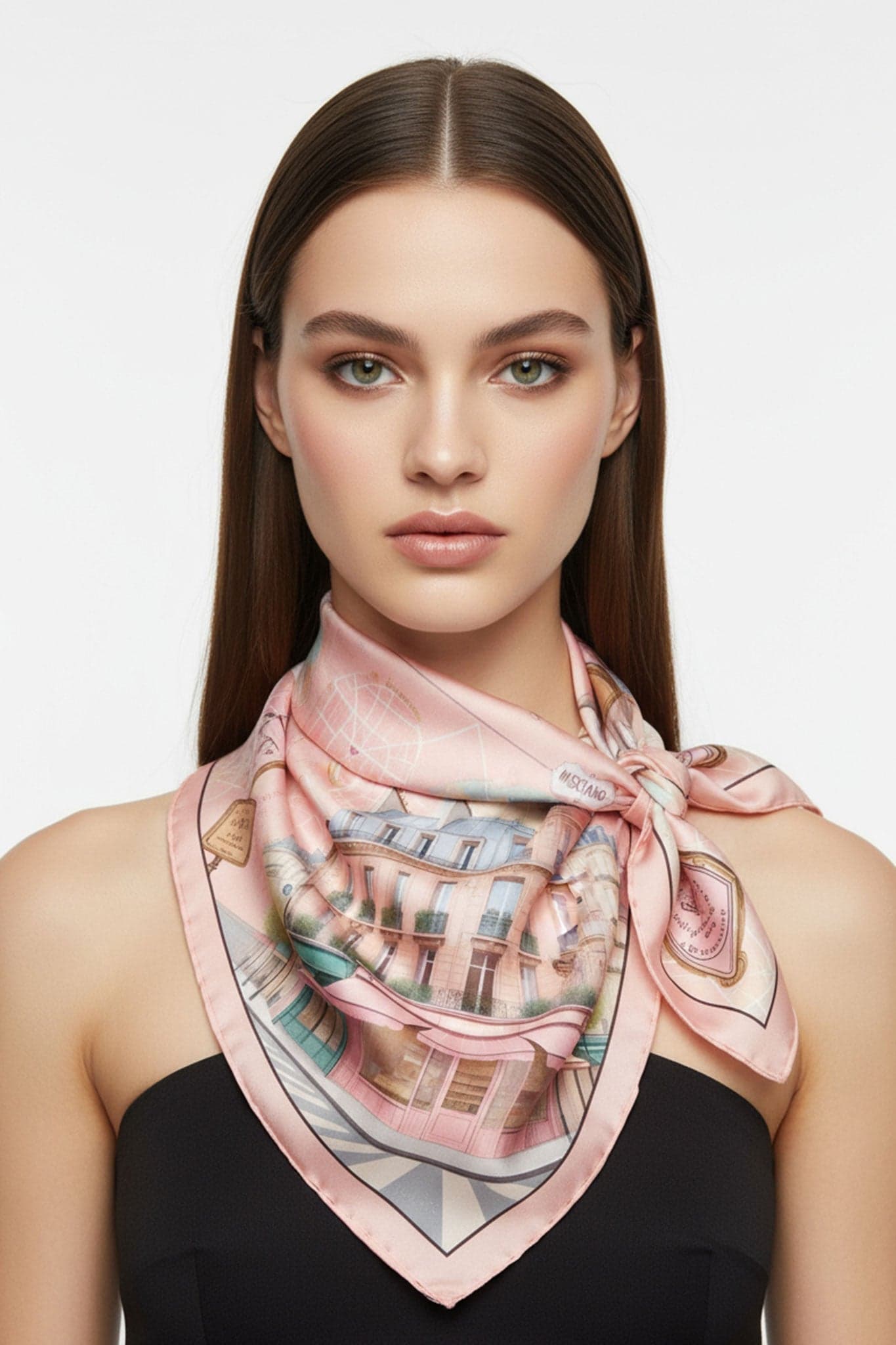
Tying a knot too tight (and believing it “holds better”)
The first mistake with a silk scarf is also the most intuitive: tightening. We think we are securing the knot, we try to “fix” the scarf, especially around the neck. Result: the silk creases into edges, the center of the knot becomes thick, and the scarf loses that soft drape that makes all its charm. Worse: by tightening in the same place, the fiber can become irregularly shiny (brighter areas), or even slightly marked at the fold if you repeat the gesture.
The unmistakable sign: you untie the knot and find a hard line, like a small “elbow” in the material. The surface is no longer uniform, the light catches in the wrong place.
The right gesture:
- Fold the scarf into a regular band (not too thin) to distribute the pressure.
- Tie leaving a micro-play: the finger should be able to pass between the knot and the band without forcing.
- Finish by shaping the knot: a fingertip pressure, not a pull.
Tip for holding without tightening: if you wear it around the neck, place the knot slightly to the side (under the ear). Gravity works for you: the scarf settles, the knot does not “rise,” and the look remains neat.
Folding too thin, too fast: the false “ribbon effect” that breaks the drape
Second common mistake: turning the scarf into a string. We roll too tight, we seek an ultra-thin band for a “clean” look. On silk, this excess of fineness often produces the opposite: the band twists, creates micro-creases, and the pattern becomes unreadable. The material loses presence, as if it apologizes for being there.
Sensorially, it's very telling: a beautiful silk has a clear glide and a freshness to the touch. When you roll it too thin, you feel resistance, a sort of tension. Visually, the light is no longer continuous: it jumps from one edge to another.
The right fold (simple and effective):
- Lay the scarf flat, wrong side facing you.
- Fold once to create a band of 6 to 8 cm.
- Fold again, without rolling: you get a stable band that does not twist.
When thinning is relevant: only if the scarf is very large or if you are looking for a jewel knot (small, precise). In this case, instead of rolling, fold in accordion: the band remains lively, the silk breathes, and the pattern retains a rhythm.
To remember: silk likes neat folds but not compressions. A “medium” band almost always gives a better drape than a too-thin ribbon.
Letting the scarf rub on “catchy” materials (sweaters, loops, bags)
Among the most costly mistakes with a silk scarf: repeated friction. Silk is strong, but its surface is sensitive to mechanical aggressions. A dry knit sweater, a slightly rough wool scarf, a textured bag strap, a belt buckle, or even a zipper can create pulls, micro-pilling, or a "scratched" appearance that dulls the shine.
Risk areas: the contact point with the bag handle (shoulder), the front of the coat (buttons), and the neck (beard, rough collar, jewelry). It's not an isolated accident: these are daily frictions, hence progressive alterations.
The right reflex:
- If you carry a bag on your shoulder, place the knot and the most visible part of the scarf on the opposite side of the handle.
- Avoid trapping the scarf under a strap or a scratchy collar.
- With a knit, opt for a shorter knot (less length to swing) or tuck the scarf inside the collar to limit friction.
Micro-detail that changes everything: before going out, run your hand over the coat/jacket where the scarf will rest. If the surface "catches" the skin, it will catch the silk.
Silk must be able to glide. If it is hindered, it wears out.
Ironing too hot, too close, or on the right side: the "broken" shine
Ironing is a minefield. The mistake is not ironing, but ironing as you would with cotton: high heat, aggressive steam, heavy pressure, and the iron directly on the right side. On silk, this can create shiny areas (hard, non-uniform shine), flatten the texture, and set creases instead of removing them. The material then loses that lively reflection, deeper than shiny.
The typical scenario: a wrinkled scarf, you want to "fix" it quickly. You insist on a crease. In the light, a lighter mark appears, like a fixed spotlight. It's often irreversible or, at best, Evening dress for women: the Misciano guide to shine with elegance.
The safe protocol:
- Iron on the reverse side, always.
- Use a press cloth (a thin cotton fabric) between the iron and the silk.
- Low to medium temperature (silk mode, about 110–150°C depending on your device), without pressing: you place the iron, you don't "push".
- If steaming: at a distance, and never saturating the fiber.
Even gentler alternative: suspended steam de-wrinkling, then flat drying. The silk naturally relaxes, and you maintain a smooth surface.
If you want a complete and coherent guide on choosing, wearing, and especially maintaining, keep this reference: Evening dress for women: the Misciano guide to shine with elegance.
Spraying perfume/hairspray directly: halos, stiffness, and "suffocated" fiber
One of the most underestimated mistakes with a silk scarf: perfuming after tying. Perfume, hairspray, certain deodorants, and body mists contain alcohol and fixatives. On silk, this can leave halos, locally harden the fiber, and alter the feel. The scarf loses its suppleness, becomes slightly “cardboard-like” at the touched spot, and the color may shift, especially on deep tones.
Why it’s tricky: at first, you see nothing. Then the light reveals a duller area, or a halo border. And since it’s localized, the eye is drawn precisely where you don’t want it to be.
The right order:
- Perfume first (on skin), let dry for 2 to 3 minutes.
- Only then, tie the scarf.
If you insist on perfuming the scarf: avoid direct spray. Prefer a very light touch on a lining, or on a garment underneath (inner collar), never on the silk itself. Silk must keep its breathability: when it is saturated with products, it loses its vibrancy.
“Emergency” tip: if a spray has touched the scarf, dab immediately with a clean, dry cloth, without rubbing. Rubbing sets the mark.
Washing too harshly (machine, hot water, spin): the hand changes
Washing is where you “damage without realizing it.” Among the mistakes with a silk scarf: water too hot, prolonged soaking, harsh detergent, vigorous spinning, or rubbing to remove a stain. Even if the scarf doesn’t tear, the hand changes: it becomes drier, less supple, and the drape loses that fluidity that gives it structure without stiffness.
What silk doesn’t like: shocks (thermal and mechanical). Hot water opens the fiber too much, spinning twists it, and rubbing breaks the surface. You may also see the edges lose sharpness or the scarf slightly deform.
The right gesture (minimalist):
- Cold to lukewarm water, short bath.
- Gentle, suitable cleaner, light dose.
- Minimal agitation: gently press, do not rub.
- Careful rinsing, same temperature.
- Flat drying, in the shade, away from a heat source.
Related mistake: hanging the wet scarf by a corner. The weight of the water pulls the weave and can create deformation. Flat, the silk regains its balance.
If you want to maintain the “fresh and dense” feel of beautiful silk, treat it like a textile that is shaped by caress, not by combat.
Treating a stain by rubbing: you win the stain, you lose the surface
Faced with a stain (foundation, oil, coffee), the reflex is to rub. This is one of the most destructive mistakes with a silk scarf, because it creates a second disaster: a bleached, fluffed, or shiny area, sometimes more visible than the initial stain. Silk has a surface that reflects light evenly; rubbing breaks this regularity.
The right immediate reflex: absorb, don't rub. Dab with absorbent paper or a clean cloth. If it's greasy, lightly sprinkle (Sommières earth if you have it), let it act, then gently remove. The idea is to extract the substance from the fiber, not to push it in.
Common case: makeup on the collar. We insist with a wipe: alcohol and rubbing double the trouble. Instead: dabbing, then gentle and localized cleaning, respecting the weave direction.
What to accept: on silk, haste is costly. It's better to stabilize the stain (absorb) and then treat it properly, rather than tearing the surface in 30 seconds.
Tactile clue: if, after intervention, the area becomes rougher than the rest, it means the surface has been damaged. In this case, stop: continuing will only amplify the difference.
Poor storage: crushed fold, yellowing, and worn edges
We believe that storage is neutral. It is not. One of the mistakes with a silk scarf: leaving it tightly folded at the bottom of a drawer, stuck under heavy items, or exposed to light near a window. Over time, the folds become more "memorized," the edges wear out, and some colors may yellow or lose depth.
Invisible risks: prolonged pressure (fixed folds), repeated friction (worn edges), continuous light (slow discoloration), and lack of ventilation (persistent odors).
Proper storage:
- Flat, in a dedicated drawer, without compression.
- Or loosely rolled, in a breathable cotton cover.
- Protected from direct light and humidity.
Believing that "all silks are worn the same": ignoring the weave and weight
Last of the mistakes with a silk scarf, and probably the most subtle: treating all scarves as if they reacted the same way. However, a twill silk, a satin, or a crepe do not behave the same way in folding, tying, or wear. Ignoring the weave and weight is forcing a scarf to play a role that is not its own.
What we often observe: a very fluid scarf tied too short that slips and comes undone; a structured twill tied tightly like a ribbon that becomes rigid; a satin worn in contact with a rough knit that shines too quickly. The result is not "failed" in the strict sense, but it lacks accuracy, and the material feels it.
Simple guidelines to avoid the mistake:
- Twill silk (twill weave): more hold, ideal for neat knots, geometric folds, neck wears that need to stay in place. It withstands repeated handling better, but dislikes excessive tightening.
- Satin silk: smooth surface, clear shine, flowing drape. Preferable for drapes, soft knots, hair or shoulder wears. It requires more width in folding and less tension.
- Very fine / light silk: requires slow gestures and more enveloping ties. Too constrained, it marks; too free, it migrates.
The right reflex: before tying, take two seconds to "read" your scarf. Weigh it in your hand, crumple it slightly, observe how it regains its shape. This micro-observation dictates the type of fold, the band width, and the right tension. This is how the scarf falls naturally, without struggle.
A silk scarf is not a standardized accessory: it is a living material. Respecting it means adapting your gesture to what it is, not the other way around.
The silk scarf rewards accuracy, not force
Most mistakes with a silk scarf do not come from a lack of taste, but from an excess of gestures: too tight, too hot, too perfumed, too rubbed. Silk is a demanding material because it is precise: it immediately reveals tension, pressure, and the quality of handling.
In practice, a well-worn and well-maintained scarf relies on a few simple principles: measured tension, regular folds, chosen contacts, and minimal intervention when a problem arises. At each stage, it is better to stop slightly too early than too late. Silk then retains its light, its feel, and its drape, without ever appearing "worked."
A beautiful scarf does not need to be constantly corrected. When respected, it stabilizes itself and accompanies the movement instead of enduring it. It is this discretion of gesture, almost invisible, that makes all the difference between a worn scarf... and a mastered scarf.
Long-term tip: change the fold from time to time. Silk has a memory: varying the folds prevents marked lines and prolongs the sharpness of the scarf.

Article by Alexander Chekushine
Published on 24/01/2026 at 10:32
About the author
A specialist in style and fashion trends, I bring a sharp eye to Misciano's creations. My in-depth knowledge of noble materials and Italian craftsmanship enriches each of my articles with a precise and demanding reading of contemporary elegance.
→ Learn more about Alexander ChekushineFREQUENTLY ASKED QUESTIONS
Why can a knot that is too tight harm the appearance of my silk scarf?
A knot that is too tight exerts excessive pressure on the silk fiber, which can cause puckering and a dull sheen. Since silk is a delicate material, it requires controlled tension to maintain its shine and elegant drape. Be sure to tie your scarf lightly to preserve its beauty.
How can I prevent my silk scarf from losing its luster?
To preserve the luster of your silk scarf, avoid using scented products or rubbing the material too much. Excessive heat can also alter its texture. Gentle care and attentive handling allow silk to maintain its brightness over time.
What actions can damage the silk fiber?
Too abrupt actions, such as pulling on the fabric or applying excessive heat during ironing, can weaken the silk fiber. It is essential to adopt a gentle approach to maintain the quality of the material and avoid damaging it.
What are the common mistakes when wearing a silk scarf?
Among the common mistakes are choosing an inappropriate knot, a poorly placed fold, or using unsuitable accessories. Every detail counts to ensure an elegant and neat wearing of the silk scarf, without compromising its appearance.
How to correct an unflattering drape of my silk scarf?
To achieve a crisp drape, ensure that the folds are well arranged and that the knot is adjusted without excess. Good ironing at a low temperature can also help revive the silk. Attention to each gesture promotes an impeccable presentation.
Our silk squares